
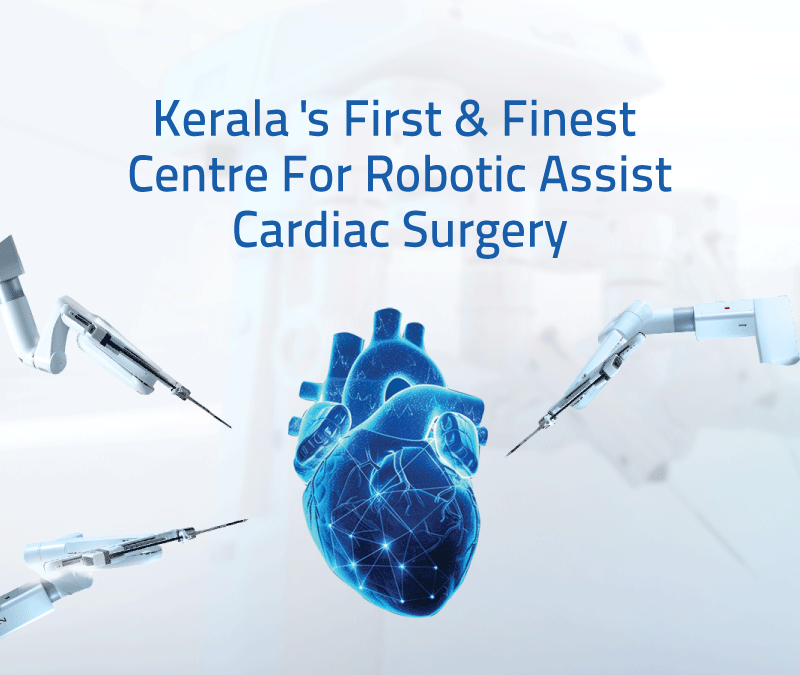
Robotic assist cardiac surgery
Aster Institute of Cardiac Sciences In Aster Medcity, expanding the cardiac service with Robot-Assisted Coronary Artery Bypass Graft Surgery which is led by Kerala’s foremost Cardio Thoracic & Vascular Surgery Team. We offer expert diagnosis and treatment across the spectrum of Cardiothoracic & Vascular Surgery.
Robotic cardiac surgery is a modern, minimally invasive approach to treating heart conditions using advanced robotic technology. Traditional open-heart surgery generally requires a large chest incision. This method is performed through small keyhole cuts. Surgeons control robotic arms from a console, which provides enhanced 3D vision, superior precision and greater flexibility. The robotic system translates the surgeon’s hand movements into highly accurate actions inside the heart. This allows complex procedures, such as valve repairs, defect closures, or bypasses, to be performed with less pain, minimal scarring, reduced risks, faster recovery and improved patient outcomes.
Why Robotic Assisted Surgery?
The robot assisted surgeries can make complex operations easier and helping in maneuvering areas not easily visible through mics. Robot assistance will improve precision of the surgical field with minor blood loss.
More accurate surgical steps will impress the surgical outcome. Timing may be longer in the initial period though the overall benefit will be that of enhanced recovery and earlier recovery to activity. Most of the patients can be considered except for preoperative cases, multiprocedural cardiac cases.
Robotic assisted is the next level in MICS even extending the cosmesis and mitigating the surgical stress making perioperative period way better in pain and post surgical complications
Conditions Addressed with Robotic-Assisted Surgery
Aortic valve disease
Atrial Fibrillation
Cardiomyopathy
Coronary artery disease
Also we are advanced surgical repertoire includes
Minimally Invasive CABG Surgery
Coronary Artery Bypass Graft (CABG)
Surgery Specialized management Aortic Aneurysm And Dissection
Heart Transplant
Mitral Valve Surgery
Aortic Valve Replacement
Minimally Invasive - Hybrid Coronary Revascularization Surgery (MIHCR)
Minimally Invasive Mitral Valve Surgery
Minimally Invasive Aortic Valve Replacement
Angioplasty
Robotic Cardiac Surgery
Minimally Invasive CABG Surgery
Transcatheter Aortic Valve Implantation (TAVI)
Advantages of Robotic Assisted Surgery
Better Cosmesis
Smaller Incisions
Less Wound Infection
ERAS Protocol
Lesser post surgical complication.
Fast Recovery
No Dreadful sternal saw & Scar
Minimal Blood loss
Less Pain
Shortest Hospital Stay
Major Advantages of Robotic Cardiac Surgery
Minimally Invasive Surgery:
In robotic-assisted surgery, surgeons use small instruments instead of their hands. Only very small cuts (usually less than 1 cm) are needed. A tiny camera helps the surgeon see inside the body clearly. This allows the robot to move carefully through blood vessels and reach difficult areas without large incisions.Less Pain:
Because the cuts are small, patients usually feel less pain and discomfort. The surgery is also more precise, which reduces damage to surrounding tissues. The internal camera and high-definition view help minimize blood loss during the procedure.Reduced Risk of Infection:
Large surgical openings increase the chance of infection. Robotic surgery uses small incisions, which lowers the risk of infection and related complications. This also helps patients recover faster and spend less time in the hospital.Higher Accuracy:
Robotic systems provide better precision during complex procedures. Surgeons can see the surgical area clearly and control the instruments more accurately. This reduces the chance of damaging healthy tissue and improves the success rate of the surgery.Enhanced Visualization:
Robotic surgery systems use high-definition 3D cameras. These cameras can magnify the surgical area up to 10 times. This helps surgeons see even very small structures clearly and perform procedures with greater accuracy.Reduced Blood Loss:
Traditional open-heart surgery often causes more blood loss because of large incisions. Robotic surgery uses small keyhole cuts and precise instruments, which reduce damage to muscles and blood vessels. Less blood loss also helps patients recover faster.

Want to find out more about the treatment? The answer to your questions can be found below.
It's the use of robotic assistance for surgeries involving the heart, lungs, and chest structures, performed through small incisions between the ribs instead of large chest openings.
The robotic system allows surgeons to work in tight spaces inside the chest without spreading ribs widely. This can mean significantly less pain, faster healing, and fewer breathing problems after surgery.
Yes. Smaller incisions mean less pain, quicker breathing recovery, shorter hospital stays, and reduced stress on the cardiovascular system, which is particularly beneficial for older patients.
Usually only for 1 day for monitoring, compared to several days after open surgery. This shorter ICU stay reflects the less invasive nature of the procedure.
Your surgeon will assess lung function before surgery. Robotic surgery is less invasive, so it's often possible in cases where open surgery might pose too high a risk.
Mitral valve repair, certain coronary bypass procedures, removal of part of the lung (lobectomy or segmentectomy), thymus gland removal, and some congenital heart defect repairs.
Yes. When performed by trained cardiac or thoracic surgeons, robotic-assisted surgery can be as safe as traditional methods, with added benefits of smaller scars and quicker recovery for many patients.
Robotic surgery avoids spreading ribs apart or cutting through the sternum, which significantly reduces post- surgery pain and accelerates healing. Most patients experience much easier breathing during recovery.
In early-stage cancers, yes. Robotic tools allow precise removal of tumours and nearby lymph nodes for accurate staging and treatment planning.
We have some of the best specialists from around the world, they bring years of experience and offer evidence-based treatment to ensure the best care for you.