
Introduction
Benign post-intubation and post-tracheostomy tracheal stenosis remains a challenging complication in interventional pulmonology and is frequently associated with recurrent airway obstruction requiring repeated bronchoscopic intervention or surgical reconstruction. Although silicone stents remain the preferred airway prosthesis for benign disease because of their favourable long-term safety profile and ease of removal, covered self-expanding metallic stents (SEMS) may occasionally be used as a temporary bridge when silicone stenting is technically not feasible or immediate airway stabilisation is required. However, prolonged implantation of covered SEMS increases the risk of epithelial incorporation, granulation tissue formation, migration, fracture, infection, and progressively difficult retrieval, making elective removal desirable whenever clinically feasible.
Conventional retrieval of covered SEMS relies on the integrity of the manufacturer's proximal retrieval lasso, which permits progressive inversion and collapse of the stent during extraction. Complete failure of this retrieval mechanism is rarely encountered and leaves the bronchoscopist with few established endoscopic rescue strategies. Published experience
describing structured endoscopic management following complete retrieval lasso failure remains extremely limited.
We report an exceptionally complex case of benign post-intubation tracheal stenosis managed over multiple staged interventions, culminating in successful retrieval of an embedded covered tracheal self-expanding metallic stent following complete failure of the manufacturer's retrieval lasso. The stent was removed using a novel coaxial rotational rigid bronchoscopic rescue technique under elective veno-venous extracorporeal membrane oxygenation (VV-ECMO)
support, providing a practical rescue strategy for one of the most challenging situations encountered in advanced interventional bronchoscopy.
Case Presentation
A 55-year-old woman with a history of hypertension and previous cerebrovascular accident underwent prolonged endotracheal intubation followed by tracheostomy at another institution. She had no history of smoking or chronic respiratory disease. Following decannulation, she
progressively developed exertional dyspnoea, wheeze, and recurrent episodes of oxygen desaturation.
She was initially referred to our centre with a presumed diagnosis of acute exacerbation of bronchial asthma. However, the persistence of inspiratory symptoms, poor response to bronchodilator therapy, and clinical suspicion of fixed upper airway obstruction prompted bronchoscopic evaluation.
Flexible bronchoscopy revealed a single-level post-intubation/post-tracheostomy tracheal stenosis involving the cervical trachea. The stenotic segment measured approximately 2 cm in length with less than 30% residual luminal patency and consisted of dense concentric fibrotic narrowing without distal airway involvement.
Given the short-segment benign stenosis and the patient's overall clinical status, endoscopic management was undertaken. Radial electrocautery incisions were performed using a flexible
bronchoscope, followed by controlled balloon dilatation. Adequate restoration of airway calibre was achieved, resulting in complete symptomatic relief. The patient remained clinically stable
without recurrence of symptoms for approximately one year.
Clinical Course
Approximately one year after the initial intervention, the patient presented with fever,
productive cough, progressive dyspnoea, and worsening respiratory distress. She had again been treated elsewhere as an acute exacerbation of bronchial asthma before referral to our centre.
Following admission to the intensive care unit, bronchoscopic evaluation was attempted but was complicated by sudden respiratory arrest requiring immediate cardiopulmonary
resuscitation. An emergency tracheostomy was performed, successfully restoring the airway and spontaneous circulation. After haemodynamic stabilisation, definitive airway intervention was deferred until the patient had recovered.
Repeat bronchoscopy demonstrated recurrent tracheal stenosis with extensive granulation tissue at the previously treated site. Cryotherapy-assisted degranulation was performed under general anaesthesia through a laryngeal mask airway. Rigid bronchoscopic coring was
subsequently attempted in preparation for silicone stent placement but was complicated by a tracheal rent with bilateral pneumothoraces, profound bradycardia, and hypotension. The diagnosis was confirmed fluoroscopically, and emergency bilateral pigtail intercostal drains were inserted, resulting in rapid physiological stabilisation. In view of the airway injury, silicone stent placement was abandoned.
Three days later, following clinical recovery, a 16 × 60 mm covered self-expanding metallic stent was successfully deployed using flexible bronchoscopy, restoring airway patency and complete symptomatic relief. Because the stent had been inserted as a temporary measure for benign airway disease, elective removal was planned after clinical stabilisation to minimise the risk of
long-term complications associated with prolonged implantation.
At the time of planned retrieval, preliminary bronchoscopic assessment again precipitated respiratory arrest requiring immediate resuscitation, invasive mechanical ventilation, and
intensive care support. Given the patient's repeated airway instability during bronchoscopic manipulation, definitive stent retrieval was subsequently planned under elective veno-venous extracorporeal membrane oxygenation (VV-ECMO) support.
Operative Technique
Pre-procedural Planning
Following stabilisation in the intensive care unit, the patient was considered to be at extremely high risk of complete airway compromise during stent retrieval because of repeated respiratory arrest during previous bronchoscopic manipulation. To provide uninterrupted oxygenation and ventilation during a prolonged airway intervention, elective veno-venous extracorporeal membrane oxygenation (VV-ECMO) was established one day before the procedure using right
internal jugular and right femoral venous cannulation. This allowed therapeutic bronchoscopy to proceed independent of airway patency.
Initial Bronchoscopic Assessment
Flexible bronchoscopy demonstrated that the covered tracheal self-expanding metallic stent remained appropriately positioned but was densely embedded within the tracheal wall with
marked epithelial incorporation. The manufacturer's proximal retrieval lasso was identified and appeared suitable for conventional retrieval.
Failure of Conventional Retrieval
Conventional retrieval was initiated by grasping the proximal retrieval lasso and applying steady traction to achieve progressive inversion of the stent. Although partial inversion of the proximal end was achieved, the retrieval lasso detached completely before adequate collapse of the stent could occur. The detached lasso was removed, leaving the embedded stent without a functional retrieval mechanism and rendering conventional endoscopic extraction impossible.
Development of the Rescue Technique
After reassessment of the airway and available instrumentation, a decision was made to proceed with an alternative rigid bronchoscopic rescue technique.
A size 10 rigid bronchoscope was introduced, and a paediatric rigid foreign-body retrieval
forceps was advanced through its lumen. The rigid telescope was passed through the lumen of the forceps, creating a coaxial assembly that provided continuous visualisation while serving as the central axis for controlled rotational manoeuvres.
The forceps securely grasped the stent approximately 5 mm distal to the damaged proximal end, avoiding the disrupted retrieval site. Gentle clockwise rotational movements combined
with controlled proximal traction progressively disengaged the embedded metallic mesh from the tracheal wall. Continuous bronchoscopic visualisation and live C-arm fluoroscopy confirmed progressive mobilisation, maintained stent orientation, and excluded distal migration.
As the stent became progressively mobilised, it telescoped into the lumen of the rigid bronchoscope, which functioned as a protective sheath during extraction. The bronchoscope, telescope, forceps, and partially collapsed stent were then withdrawn as a single integrated
assembly under continuous visual and fluoroscopic guidance.
The stent became impacted at the glottic inlet. Direct laryngoscopy was therefore performed,
and a flexible bronchoscope was introduced. Flexible biopsy forceps were advanced through the working channel to grasp the proximal end of the stent, allowing controlled translaryngeal
extraction under combined laryngoscopic and bronchoscopic guidance.
Post-retrieval bronchoscopy confirmed complete removal of the stent with a widely patent airway, expected mucosal trauma and minor bleeding, and no retained metallic fragments or major airway disruption.
Post-Procedural Airway Surveillance and Critical Care
Immediately after successful retrieval of the covered tracheal self-expanding metallic stent, flexible bronchoscopy confirmed complete stent removal without retained metallic fragments. The tracheal lumen was widely patent with expected mucosal trauma and minor oozing related to separation of the embedded stent from the tracheal wall. No residual tracheal rent, major airway disruption, or uncontrolled haemorrhage was identified. Because systemic
anticoagulation was required for ongoing VV-ECMO support, planned bronchoscopic surveillance was undertaken to monitor for delayed airway complications.
On the first post-procedural day, surveillance bronchoscopy demonstrated extensive
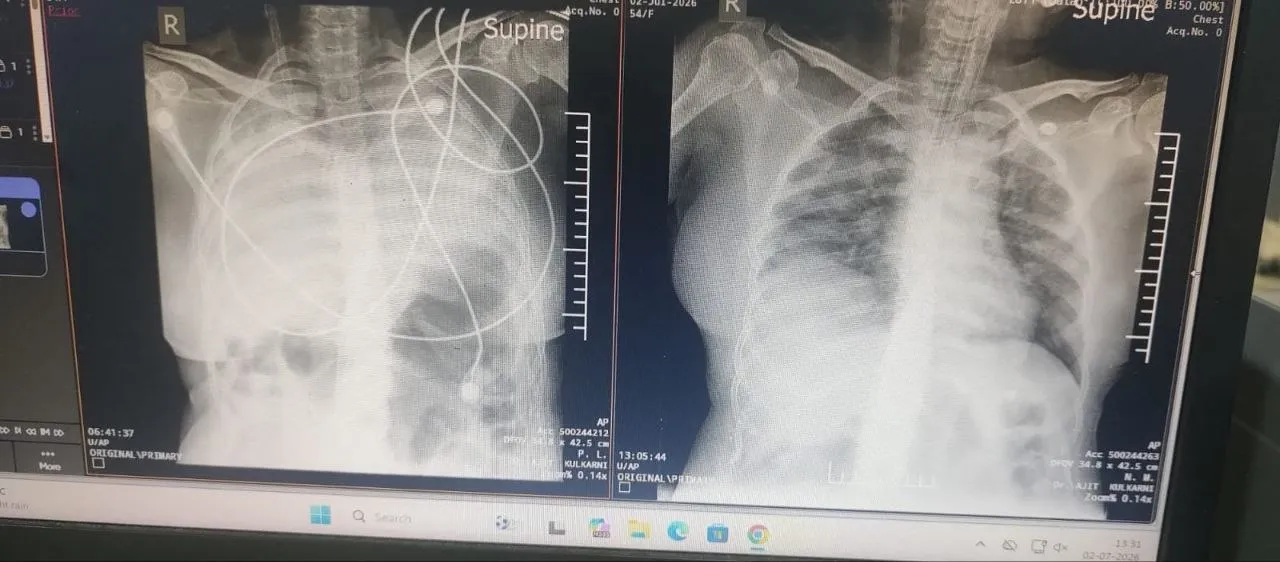
endobronchial blood clot formation causing significant airway obstruction, with corresponding near-complete opacification of the affected hemithorax on chest radiography. Therapeutic flexible bronchoscopy with cryo-extraction successfully removed the organised clots, restoring
airway patency while minimising further mucosal trauma. The patient was subsequently
electively intubated to protect the airway and facilitate continued respiratory support during ECMO.
During the same period, the patient developed sepsis, which was managed with
culture-directed broad-spectrum antimicrobial therapy, resulting in progressive haemodynamic recovery.
Following gradual withdrawal of sedation, neurological assessment confirmed complete recovery without deficit. Repeat surveillance bronchoscopy before planned extubation demonstrated a widely patent tracheobronchial tree with satisfactory mucosal healing and no recurrent clot burden. The patient was successfully extubated under bronchoscopic guidance, subsequently weaned from VV-ECMO after six days of extracorporeal support, and discharged home five days later, asymptomatic and breathing comfortably on room air.
Discussion
Removal of covered self-expanding metallic stents (SEMS) from the benign airway is generally recommended once the underlying airway pathology has stabilised, thereby minimising
long-term complications associated with prolonged implantation. Conventional retrieval relies
on the manufacturer's proximal retrieval lasso, which enables progressive inversion and collapse of the stent during extraction. Although difficult retrieval secondary to epithelial incorporation
and granulation tissue is well recognised, complete failure of the retrieval lasso is exceptionally uncommon and leaves the bronchoscopist with few established endoscopic rescue options.
This case was technically challenging because the stent had remained in situ long enough to become densely epithelialised and firmly adherent to the tracheal wall. In addition, prior airway manipulation had already demonstrated that even limited instrumentation could precipitate respiratory arrest and airway injury. These factors made further retrieval hazardous and justified elective removal under VV-ECMO to maintain oxygenation and ventilation throughout the procedure.
The principal technical contribution of this report is the successful endoscopic management of complete retrieval lasso failure using a coaxial rotational rescue technique. Rather than relying on forceful linear traction, the stent was grasped distal to the disrupted proximal end, allowing controlled rotational disengagement of the embedded metallic mesh from the tracheal wall.
Progressive telescoping of the mobilised stent into the rigid bronchoscope facilitated protected extraction while minimising uncontrolled airway trauma. Continuous bronchoscopic
visualisation and fluoroscopic guidance ensured maintenance of orientation throughout the procedure and confirmed complete retrieval without retained fragments.
Elective VV-ECMO played an important supportive role by providing uninterrupted oxygenation and ventilation during prolonged airway manipulation in a patient at high risk of airway loss.
Although ECMO should not be considered routine for airway stent retrieval, it may be a valuable adjunct in carefully selected patients with severe airway instability, prior arrest, or anticipated prolonged manipulation in whom conventional ventilation may be unsafe.
The postoperative course further emphasised the importance of structured airway surveillance. Bleeding from the extensively epithelialised tracheal mucosa was anticipated following retrieval and was further influenced by systemic anticoagulation required for ECMO support. Scheduled surveillance bronchoscopy enabled early identification of extensive endobronchial clot
formation and prompt therapeutic cryo-extraction before further respiratory compromise occurred, highlighting the value of proactive postoperative airway monitoring in selected high-risk patients.
This report has inherent limitations as a single-case experience, and the technique should not be considered universally applicable. Successful implementation requires expertise in advanced rigid bronchoscopy, familiarity with complex airway interventions, and access to ECMO where appropriate. Nevertheless, the principles described may offer a practical rescue strategy when conventional covered SEMS retrieval fails because of complete disruption of the manufacturer's retrieval lasso.
Technical Pearls
- Complete failure of the manufacturer's retrieval lasso does not necessarily preclude successful endoscopic retrieval of an embedded covered tracheal self-expanding metallic stent.
Elective VV-ECMO can provide a controlled environment for prolonged complex airway
interventions in carefully selected patients with anticipated airway instability or high risk of respiratory collapse.
- Secure grasping of the proximal stent framework distal to the disrupted retrieval point permits controlled rotational disengagement of the embedded metallic mesh while avoiding forceful linear traction.
- Progressive telescoping of the mobilised stent into the rigid bronchoscope facilitates protected extraction and may reduce uncontrolled airway trauma.
- Continuous bronchoscopic visualisation combined with fluoroscopic guidance assists in maintaining stent orientation, confirming progressive mobilisation, and identifying complications during retrieval.
Planned postoperative bronchoscopic surveillance is particularly valuable in
anticoagulated patients, allowing early recognition and treatment of airway bleeding and obstructing endobronchial clot formation.
Although this technique requires expertise in advanced rigid bronchoscopy and should not be considered routine, it may provide a practical rescue option when conventional
covered SEMS retrieval fails because of complete disruption of the manufacturer's retrieval lasso.
Conclusion
This report describes successful endoscopic retrieval of an embedded covered tracheal
self-expanding metallic stent following complete failure of the manufacturer's retrieval lasso using a novel coaxial rotational rigid bronchoscopic rescue technique under elective VV-ECMO support. The technique enabled controlled disengagement of the embedded stent and safe extraction.
Beyond the technical innovation, this case highlights the importance of meticulous procedural planning and structured postoperative airway surveillance in managing complex airway
interventions. Although broader clinical experience is required to establish its generalisability, the principles described in this report may provide a practical rescue strategy for selected
patients in whom conventional covered SEMS retrieval is unsuccessful. Ultimately, when airway rescue becomes necessary, success depends not only on technical ingenuity but also on
disciplined preparation and unwavering attention to patient safety.
Keywords
- Benign tracheal stenosis
- Airway stent retrieval
- Self-expanding metallic stent (SEMS)
- Rigid bronchoscopy
- Veno-venous extracorporeal membrane oxygenation (VV-ECMO)
- Retrieval lasso failure
- Interventional pulmonology
- Airway rescue