
1. Patient Profile
- Age/Gender: 12-year-old female
- Incident: Fall during play at school (direct impact over abdomen)
2. History of Presenting Illness
The child was playing “catch and cook” with her friends at school when she accidentally slipped and fell directly onto her abdomen.
Following the fall, she developed:
- Severe pain in the Right Upper Quadrant (RUQ)
- Progressive abdominal distension
- Increasing abdominal tenderness
- One episode of dizziness
She was initially evaluated at an outside facility where an ultrasound was performed.
3. Initial Investigation (Outside Facility)
Ultrasound (USG) Findings:
- Very large heterogeneous hyperechoic hematoma
- Laceration involving Segments V, VI, VII, and VIII of the liver
- Moderate hemoperitoneum
- Diagnosed as Grade III Liver Injury
She was urgently referred to Aster Aadhar Hospital, Kolhapur for higher-level trauma care.
4. Emergency Department Assessment at Aster Aadhar Hospital
On arrival, the child was hemodynamically unstable.
General Condition:
- Pale
- Anxious
- Complaining of severe abdominal pain
Vital Signs:
- Pulse: 138 beats/min (tachycardia)
- Blood Pressure: 86/54 mmHg (hypotension)
- Respiratory Rate: 28 breaths/min (tachypnea)
- SpO₂: 97% on room air
- Capillary Refill Time: >3 seconds
- Temperature: 36.5°C
Systemic Examination:
- Marked tenderness in RUQ
- Guarding present
- Abdominal distension
- Signs suggestive of intra-abdominal bleeding
Laboratory Findings:
- Haemoglobin: 6.7 g/dL
- Haematocrit significantly reduced
- Other trauma labs sent urgently
The clinical picture was consistent with hemorrhagic shock secondary to blunt abdominal trauma.
5. Emergency Management & Imaging
Immediate resuscitation initiated:
- Two wide-bore IV cannulas secured
- Crystalloid bolus administered
- Blood samples sent for cross-matching
- Packed Red Blood Cells (PRBC) transfusion initiated
- Oxygen support provided
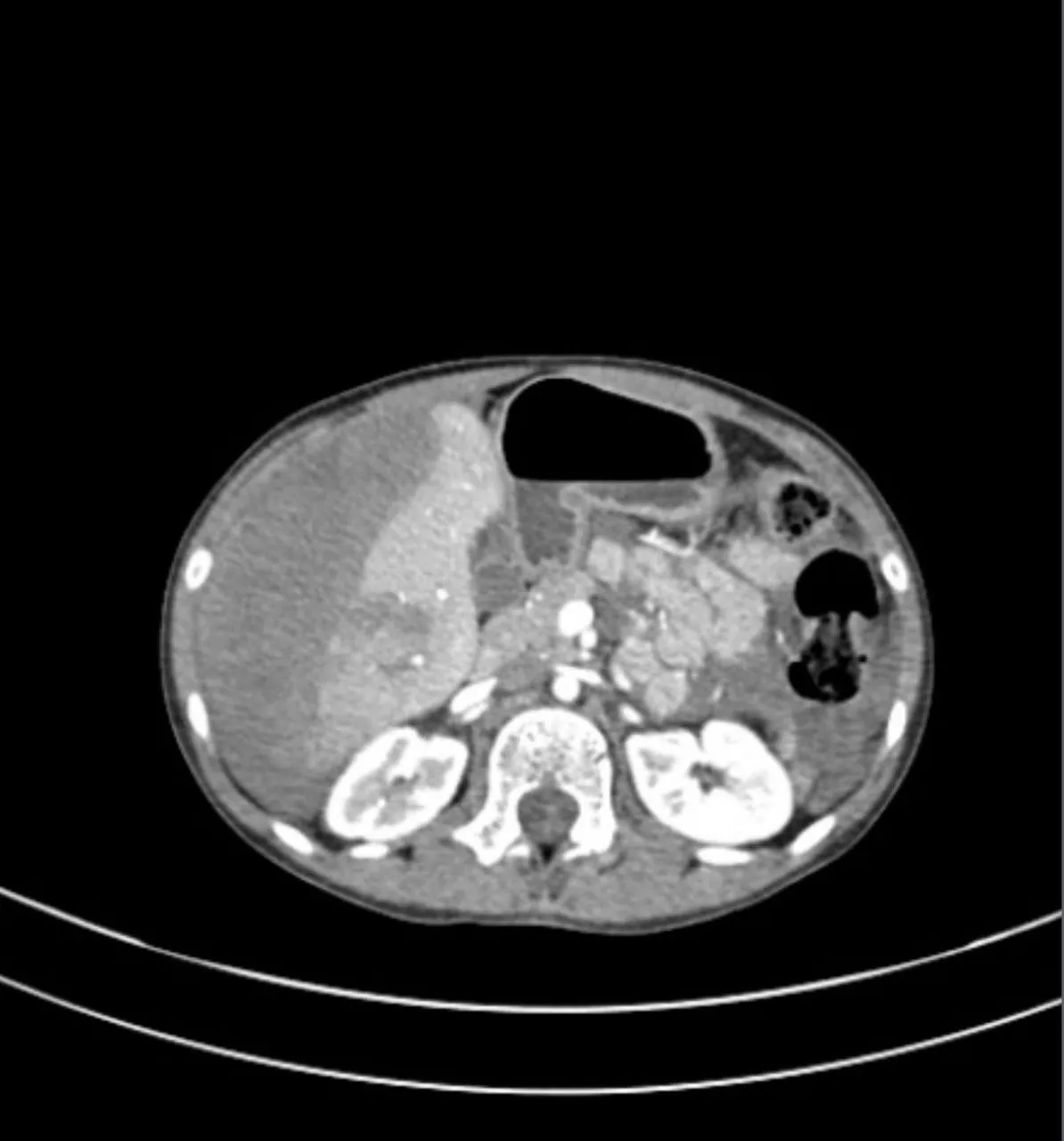
After partial stabilization, urgent contrast-enhanced CT Abdomen and Pelvis was performed.
CT Findings:
- Large subcapsular hepatic hematoma
- Deep parenchymal laceration involving right lobe (Segments V–VIII)
- Active contrast extravasation suggestive of ongoing bleeding
- Moderate hemoperitoneum
- Confirmed Grade III hepatic trauma
6. Management Decision
Considering:
- Hemodynamic instability
- Severe anemia (Hb 6.7 g/dL)
- Imaging suggestive of active bleeding
- Significant hemoperitoneum
The decision was taken for emergency surgical intervention.
The patient was shifted immediately to the Operation Theatre.
7. Procedure Performed
- Exploratory Laparotomy
- Evacuation of hemoperitoneum
- Identification of right lobe liver laceration
- Control of active hepatic bleeding
- Hemostasis achieved
- Placement of abdominal drain
Intraoperative blood transfusion continued.
8. Post-Operative Course
- Shifted to monitored care (PICU)
- Continued blood transfusion and close hemodynamic monitoring
- Gradual stabilization of vitals
- Serial haemoglobin monitoring
- Drain output monitored
- Progressive recovery under paediatric and surgical supervision
The patient improved steadily and was discharged in stable condition with follow-up advice.
Key Highlights
✔ Early recognition of hemorrhagic shock
✔ Rapid trauma resuscitation protocol
✔ Advanced imaging confirmation
✔ Timely surgical intervention
✔ Multidisciplinary paediatric trauma management
✔ Successful outcome in severe blunt liver injury
Clinical Significance
Blunt abdominal trauma in children may initially appear deceptively stable but can rapidly progress to hemorrhagic shock.
This case emphasizes:
- The importance of early resuscitation
- Vigilant monitoring of haemoglobin levels
- Timely surgical decision-making in unstable patients
- Coordinated paediatric trauma response
This case demonstrates Aster Aadhar Hospital, Kolhapur’s expertise in managing complex paediatric trauma emergencies with precision, speed, and multidisciplinary coordination.