

It’s common for patients to ask how doctors assess kidney function. Unfortunately, there isn’t a single simple answer. The kidneys perform several vital tasks — filtering waste, balancing electrolytes, and maintaining fluid balance — so a combination of tests is needed to judge how well they work.
Among the many investigations, two tests are particularly important for understanding kidney health:
- Serum Creatinine – a blood test that reflects how efficiently your kidneys filter waste.
- Urine Albumin Measurement – a urine test that checks for leakage of protein, an early sign of kidney damage.
Let’s look at each in detail.
Serum Creatinine
Creatinine is a natural waste product formed from ongoing muscle metabolism. Your body produces roughly 1 gram of creatinine per day, and your kidneys filter nearly all of it out through urine.
In a healthy person, the blood creatinine level stays fairly constant — usually between 0.8 to 1.2 mg/dL. When the kidneys’ filtering ability (filtration) slows down, creatinine levels rise. The higher the level, the more significant the kidney problem.
- Acute rise in creatinine (hours to days): suggests Acute Kidney Injury (AKI).
- Gradual rise over months or years: points toward Chronic Kidney Disease (CKD).
To get a more precise measure of kidney function, doctors use the Glomerular Filtration Rate (GFR) — the amount of blood filtered by the kidneys every minute. The GFR can be estimated (eGFR) using your serum creatinine level, age, and gender through online or mobile calculators (for example, NKF eGFR calculator).
In CKD, it’s more useful to look at eGFR rather than just creatinine, because eGFR helps stage the disease. Each stage provides guidance on treatment, monitoring frequency, and risk of progression.
Urine Albumin Measurement
The second key test looks for albumin, a type of protein that should normally stay inside the bloodstream. If urine contains albumin, it indicates the kidney’s filtration barrier is leaking, often an early sign of kidney damage.
Unlike a blood test, this one doesn’t require a needle. There are a few ways to measure it:
- Urine Dipstick Test: A simple semi-quantitative test done on a random urine sample, showing results as trace, +, ++, +++, or ++++ depending on the amount of albumin.
- 24 Hour Urine Protein Estimation: The most accurate method but inconvenient to perform.
- Albumin-to-Creatinine Ratio (ACR): A practical spot test that correlates well with 24 hour protein results.
Urine albumin categories:
- A1: < 30 mg/day – Normal
- A2: 30–300 mg/day – Microalbuminuria
- A3: > 300 mg/day – Macroalbuminuria
Albumin leak is especially important in conditions like diabetic kidney disease, where it can appear before any rise in serum creatinine — making it a critical early warning sign.
Combining the Two Tests
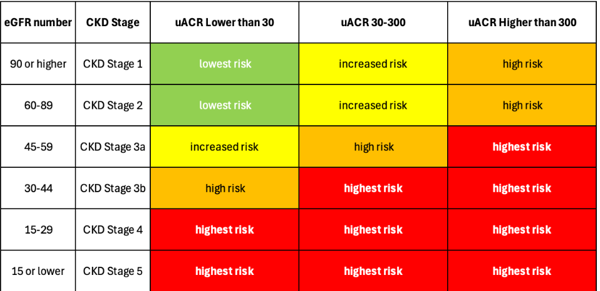
When results of serum creatinine (via eGFR) and urine albumin are combined, they provide a comprehensive picture of kidney health. In chronic kidney disease assessment, nephrologists often use a color-coded heat map where:
- Green indicates low risk,
- Yellow/Orange suggests moderate risk, and
- Red denotes high risk of kidney failure or complications.
Together, these tests help doctors diagnose, stage, and monitor kidney disease, allowing timely interventions and lifestyle modifications to protect kidney function.
In Summary
The serum creatinine test and urine albumin measurement complement each other.
- Creatinine/eGFR tells how well the kidneys are filtering.
- Urine albumin tells whether the filter barrier is intact.
Understanding both values is the best way to track kidney health — and to act early if something is amiss.