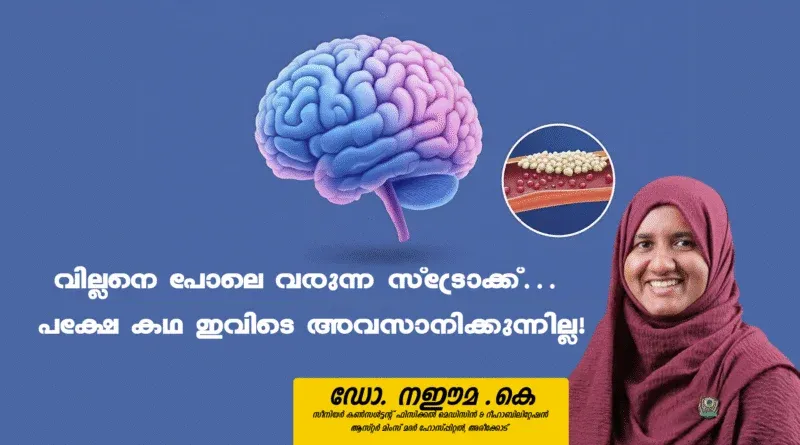
A stroke can strike unexpectedly when life seems to be moving along as usual. When someone we love suddenly struggles to speak or collapses because one side of their body has become weak, it is not just the individual who suffers—the entire family is affected. As everyone waits anxiously outside the ICU, holding their breath, the same question fills their minds: “Will they ever be able to walk and speak like before?”
The answer lies partly in the time and effort invested in recovery. Many people believe that complete rest is what a stroke survivor needs to regain their life. However, this is where they may go wrong. The days following a stroke are not meant to be spent lying in bed without activity. They are an opportunity to stimulate and retrain the brain. Alongside medical treatment, timely rehabilitation plays a crucial role in determining the patient's quality of life. This is where the specialty of Physical Medicine and Rehabilitation (PM&R) helps.
The Magic of the Brain: What Is Neuroplasticity?
Thinking that a part of the brain has been permanently damaged by a stroke can feel like looking at a large tree whose branches have broken off. With proper care, water, and nourishment, new leaves and shoots can emerge. Our brain has a similar ability. It can find new pathways to compensate for damaged neural connections. In medical science, this ability is known as neuroplasticity.
Every small exercise and training activity performed at a rehabilitation centre helps the brain develop these new pathways. With consistent practice and appropriate rehabilitation, the brain can gradually adapt, helping patients relearn essential skills and regain lost functions.
Rest Is Not All You Need Now
Many people think, “Let the weakness and exhaustion settle down first; then we can slowly start getting up.” However, excessive and prolonged rest can lead to serious complications.
Rehabilitation can often begin even while the patient is in the ICU, under medical supervision and according to their health condition. Remaining immobile for long periods can lead to muscle weakness and stiffness. It can also increase the risk of pressure sores, lung infections, and complications such as deep vein thrombosis (DVT), in which blood clots form in the veins of the legs.
Therefore, starting rehabilitation early, when medically appropriate, is essential to help prevent these complications.
With proper training and correct positioning, patients can gradually relearn how to sit, stand, and walk. For those experiencing difficulties with speech or swallowing, early speech and swallowing therapy can help improve functional abilities and support better recovery outcomes.
Recent Advances and Robotics
Rehabilitation is no longer limited to conventional exercises that involve moving the arms and legs. Advanced technologies are now helping patients recover more effectively.
Robotic rehabilitation can assist patients who have severe difficulty moving their limbs by enabling controlled and repetitive exercises. Repeating the same movements consistently can help the brain relearn movement patterns and support neuroplasticity.
Virtual reality therapy allows patients to exercise through interactive, video-game-like experiences. By practising activities such as balancing and walking in a virtual environment, patients can remain engaged and motivated while working towards regaining their physical abilities. This approach can also help improve balance.
In addition, Functional Electrical Stimulation (FES) may be used to stimulate nerves and muscles to improve muscle activation and movement.
Modern gait training systems also provide safe, supported environments in which patients can practise walking with assistance from specialised support systems, reducing the fear of falling.
The Family Is an Essential Part of Recovery
Recovery is not the magic of a doctor alone. It is a team effort involving physiatrists, physiotherapists, occupational therapists, speech therapists, nurses, and other healthcare professionals.
But do you know who one of the most important members of this team is? The patient's family.
The confidence that comes from holding a weakened hand, the patience to listen to words that are difficult to understand, and the encouragement offered when even a small improvement is noticed—these acts of love and support are invaluable during recovery.
Family involvement can help patients stay motivated, practise their skills, and face the challenges of rehabilitation with greater confidence.
Life Does Not End Here
A stroke is not the end of life. It is the beginning of a new chapter that may be challenging but can still hold hope and possibilities.
Recovery is different for every individual, and complete recovery may not be possible for everyone. Nevertheless, the goal of rehabilitation is to help each patient regain as much independence as possible, perform daily activities with less assistance, and return to society with confidence and a smile.
Every small effort made at the right time can help guide a patient from darkness towards light. On the road to recovery, every second is precious.