
Dr.Khushboo Bhatt (PT): I spend my days with people rebuilding their heart's capacity after it's already sent them a warning they couldn't ignore. Almost every one of them says some version of the same thing: "I had no idea it was building up. I felt fine."
That sentence is the reason this page exists. Not to scare you — to give you the version of this conversation I wish more people got before they needed me professionally.
You don't need less information. You need the right five or six things, said plainly, by someone who's watched what actually matters versus what just sounds like it should.
Your Heart Isn't Waiting for You to Get Sick
Most people file "heart health" under someday, if something goes wrong. It's actually running your today — your focus, your recovery, your patience in a hard negotiation. The heart most people picture as a future problem is, in fact, a present-tense performance engine.
That reframe changes everything that follows.
What Actually Moves the Needle — In the Order It Actually Matters
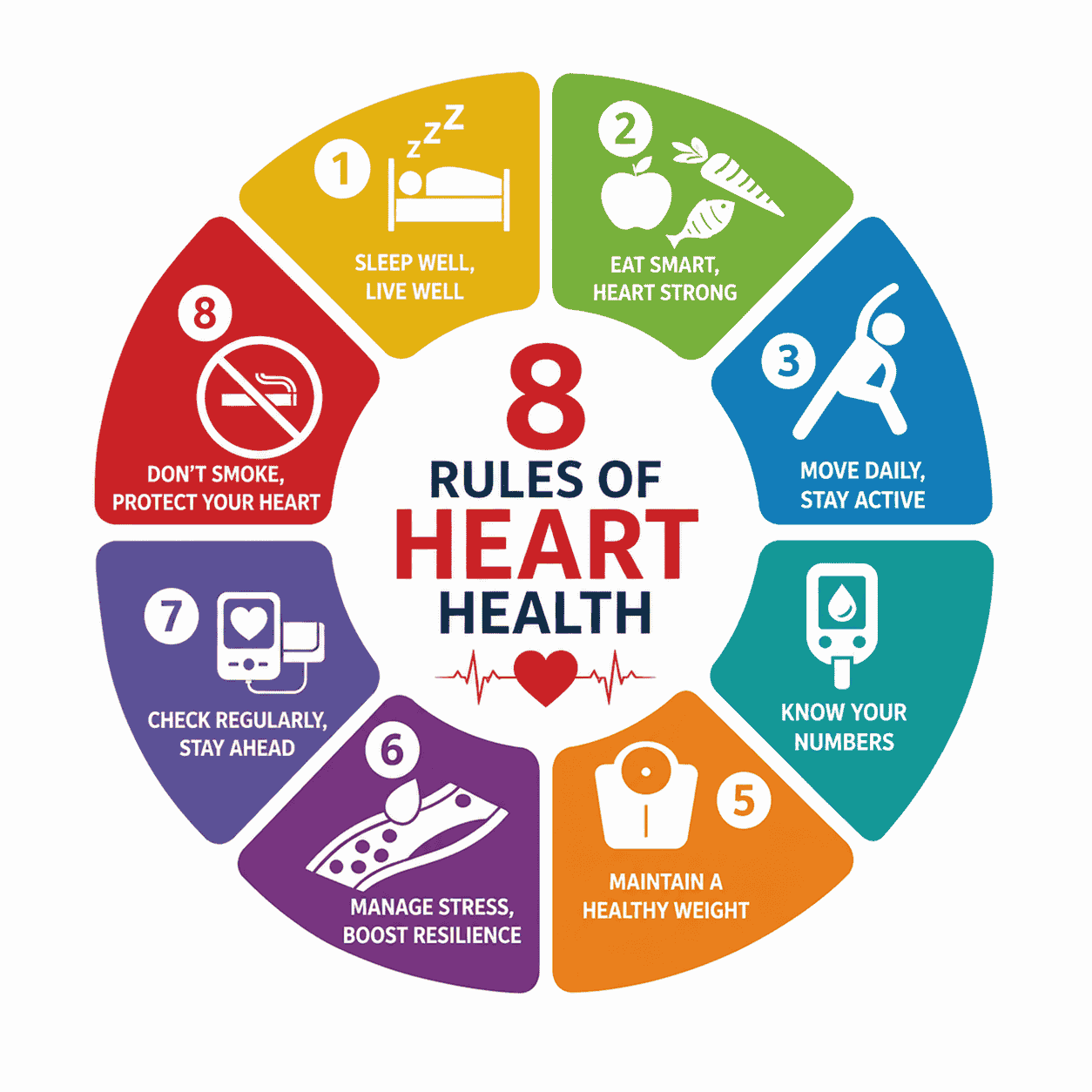
1. Movement Beats Exercise
Most executives I meet exercise and are still at risk — because the workout is 45 minutes and the day is 14 hours. A hard gym session doesn't undo nine hours of sitting between two meetings and a flight. The goal isn't more intensity. It's fewer long stretches of stillness. Stand between calls. Take one meeting a day walking. And judge intensity by your vitals — heart rate, recovery time — not by how much you sweated or how tired you feel afterward. Tiredness tells you the workout was hard. It doesn't tell you it was effective.
2. Recovery Is Not a Reward — It's a Requirement
Training stresses the heart. Sleep and downtime are where it actually adapts and gets stronger. Skip that half of the equation and you're accumulating stress with no adaptation — which is a very specific, very common pattern I see in people who "do everything right" and still end up in my clinic. 7–9 hours of sleep isn't self-care. It's the maintenance window your heart runs its repairs in.
3. The Interruption Is Worse Than the Deadline
One big stressful event spikes your system and lets it recover. Forty small interruptions a day — pings, calls, "quick" questions — never let it fully come down. Your body runs on two switches — one that revs you up, one that calms you down — and constant interruptions keep the "on" switch flipped before the "calm" one gets a turn. That's how blood pressure quietly climbs with no dramatic moment behind it. Know your number — not from one calm clinic reading, but as a running average.
4. The Waistline Tells a Truer Story Than the Scale
Two people can weigh the same and carry very different risk — what matters is where the weight sits. A tape measure tells me more in ten seconds than most people's annual weigh-in does.
For the Indian population, the cutoffs are tighter than global averages: waist circumference under 90 cm for men and 80 cm for women. One more number worth knowing — your waist-to-height ratio: keep your waist under half your height. It's a simple check that flags risk earlier than BMI does, especially for people who look "fit" but carry weight centrally.
5. Cholesterol Doesn't Announce Itself
This is the number with zero symptoms until it isn't. Plaque builds in arteries silently for years — no pain, no warning, no "off" day that tips you off. The only way to know is to check it, on purpose, before you have a reason to. Waiting for a symptom is waiting too long by definition.
Family history changes the checklist, not just the risk. If a parent or sibling had a heart attack, stroke, or high cholesterol at a young age, a standard lipid panel isn't enough — ask for the extended workup, including markers like Lipoprotein(a), which is inherited and won't show up on a routine test unless it's specifically ordered.
6. Blood Sugar Damage Starts Long Before "Diabetic"
Most people wait for a diagnosis label before they think this applies to them. Vessel damage from elevated blood sugar begins well before any official cutoff is crossed — in the "borderline," "keep an eye on it" years that get dismissed the most. This is the number most likely to be quietly rising while every other report still reads "normal." And it's not just the number that matters — sharp daily spikes and crashes damage vessels even when your average reads fine.
7. Eat Like Someone Who Has a 6 PM Board Call
Forget diet culture. Ask one question about every meal: will this sustain my energy for the next five hours, or spike and drop it? Vegetables, whole grains, real protein, good fats — not because they're virtuous, but because they're the only inputs that don't crash your focus by 3 PM. Hydration matters more than most people budget for; mild dehydration alone measurably dulls concentration.
8. Nicotine Has No Neutral Version
Every form — cigarettes, vaping, chew — damages vessels the same way. This is the one item on this list with no nuance and no moderate version. If you've been meaning to quit, this is your sign that "eventually" is costing more than you think.
The 60-Second Check
Score one point for every "yes." No judgment, no diagnosis — just a mirror.
☐ I move — genuinely move — most days, not just on gym days
☐ I get at least 150 minutes of activity a week
☐ I do something strength-based at least twice a week
☐ I sleep 7–9 hours on most nights
☐ I know my current blood pressure
☐ I know my current cholesterol
☐ I don't use tobacco or nicotine in any form
☐ Two flights of stairs don't leave me winded
☐ I break up long sitting stretches during the workday
☐ I usually have energy left over at the end of my workday
8–10: Your foundation is solid. The next gain is consistency, not more effort.
5–7: Good bones. Pick one line above and rebuild it deliberately for a month.
0–4: Worth a proper conversation with someone who can build you a real plan — not another generic checklist.
Before You Close This Page
One question, no need to answer it out loud:
What's one habit, repeated daily, that your future self — five years from now, still performing at this level — would thank you for starting today?
Write it down. Not seven habits. One. The people who actually change something are the ones who picked one thing and kept it, not the ones who tried to fix everything on a Monday.
Take This Further
If today's session raised a question you didn't get to ask, or you want a structured plan built around your own numbers, Aster's cardiac rehabilitation and preventive cardiology team can help. [Link to program →]
Dr. Khushboo Bhatt, MPT, CRFC
📧 [email protected]
YouTube Videos:
Preventive Cardiology & Cardiac Rehabilitation at Aster CMI
This content is intended for general awareness and education only. It is not medical advice, diagnosis, or a prescription, and it does not replace consultation with a qualified physician. Please speak with your doctor before making changes based on your personal health status.
Your heart doesn't ask for a perfect week. It asks for a repeatable one.