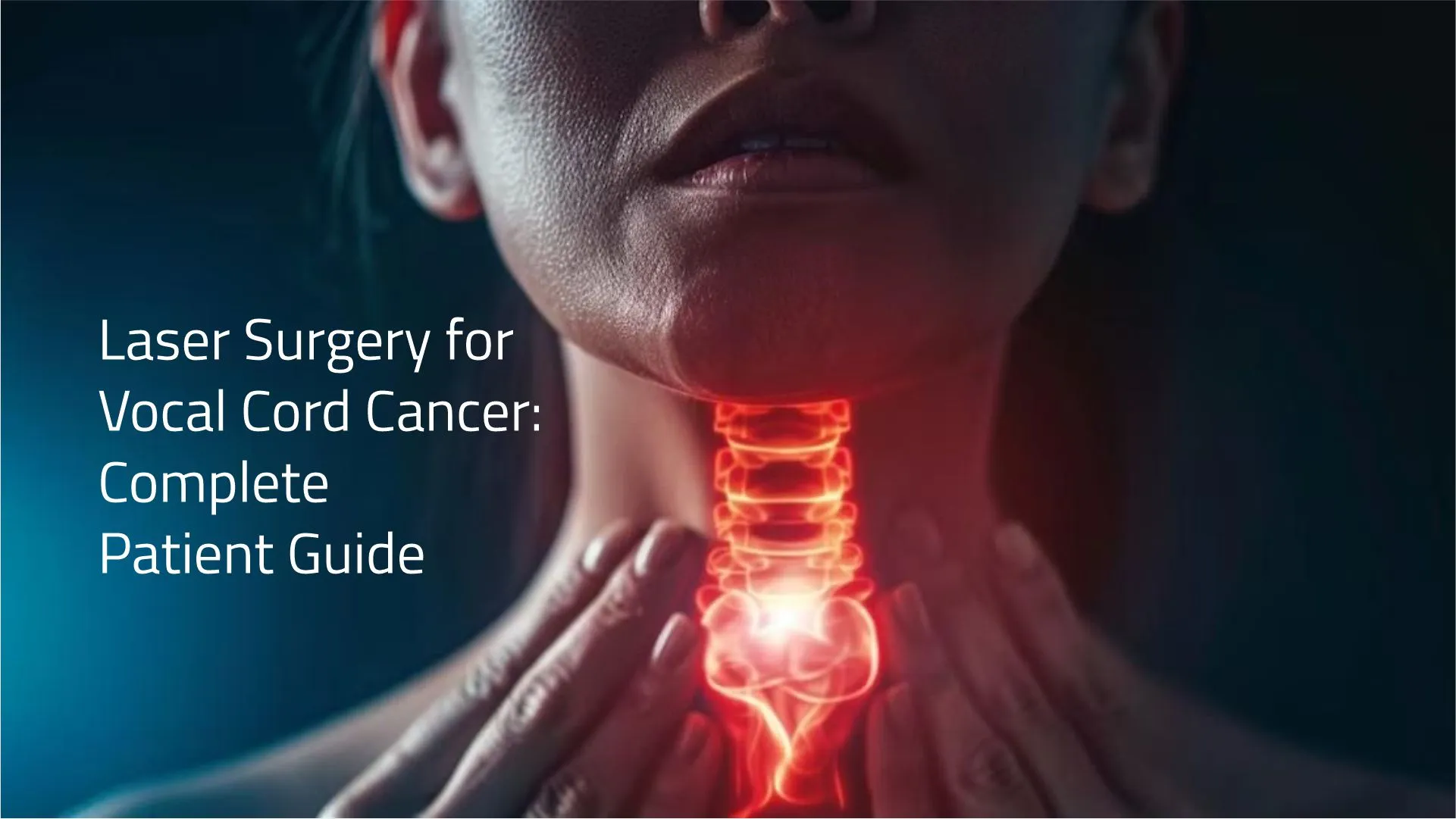

What is Laser Surgery for Vocal Cord Cancer?
Laser surgery for vocal cord cancer uses a specialized CO2 laser to precisely remove cancerous tissue from your vocal cords. The surgeon uses a microscope to see the exact tumor and removes only the cancer, leaving healthy vocal cord tissue intact.
The procedure:
· Takes 30 minutes under general anesthesia
· Performed in operating theater
· You go home same day
· Minimal post-operative pain
· Quick return to normal activities
When is Laser Surgery Used?
Laser surgery is recommended for early-stage vocal cord cancer (Stage I and early Stage II):
· Cancer confined to one vocal cord
· No spread to lymph nodes
· No involvement of other laryngeal structures
· Vocal cord moves normally
If your cancer has spread beyond one vocal cord or involves lymph nodes, laser surgery isn't appropriate. Your doctor will recommend radiation therapy or chemotherapy instead.
Laser Surgery vs. Radiation Therapy: Comparison
Factor Laser Surgery Radiation Therapy
Treatment Duration 1 procedure (30 min) 6 weeks (daily sessions)
Hospital Visits 1 day 30+ visits
Recovery Time 1-2 weeks 6+ weeks
Factor Laser Surgery Radiation Therapy
Permanent Side Effects Rare Common (dry mouth, voice changes)
Diet Restrictions None after 1 week May persist months
Voice Outcome Usually normal May have permanent changes
Local Control Rate (Stage I) 90-95% 90-95%
Cost Varies by facility Varies by facility
Recovery Timeline After Laser Surgery
Week 1: Voice sounds raspy, throat feels sore. This is normal swelling from the procedure. Pain is mild.
Weeks 2-3: Swelling decreases. Voice gradually improves. Most people sound nearly normal.
Weeks 4-6: Complete voice recovery. Return to full activities.
6-8 weeks: Voice typically back to baseline.
Most patients can:
· Eat normally within 24 hours
· Return to work within 1 week
· Resume exercise within 2 weeks
· Speak normally within 4-6 weeks
Cure Rates: What the Data Shows
For appropriately selected Stage I vocal cord cancer patients, both treatments achieve similar local control rates (cancer doesn't come back in that location):
· Laser surgery local control: 90-95%
· Radiation therapy local control: 90-95%
The key difference isn't cure rate. It's side effects and quality of life during and after treatment. Laser achieves the same cancer control with fewer long-term complications.
Advantages of Laser Surgery
✓ Shorter overall treatment time (1 day vs. 6 weeks)
✓ Better quality of life during treatment
✓ Fewer permanent side effects
✓ Faster return to normal voice
✓ No damage to surrounding healthy tissue
✓ Can be repeated if needed (radiation cannot)
✓ No long-term fatigue or dry mouth
✓ Same cure rates as radiation
Limitations of Laser Surgery
✗ Only works for early-stage disease
✗ Not all hospitals have the equipment
✗ Requires specialized surgical training
✗ Not available everywhere
✗ Requires operating theater access
Key Questions to Ask Your Doctor
1. Is my cancer Stage I or early Stage II? (determines eligibility)
2. Is laser surgery available at this hospital? (some facilities lack equipment)
3. How many laser procedures have you performed? (experience matters—ask for 50+ cases minimum)
4. What are local control rates at your hospital specifically? (should be 90%+)
5. If laser isn't available, can I get referral to center that offers it? (worth traveling for)
6. What happens if laser doesn't work? (backup plan should be radiation)
7. What are realistic voice outcomes? (usually good, but varies by individual)
How Laser Surgery Works Step-by-Step
1. General anesthesia administered
2. Laryngoscope (viewing instrument) inserted through mouth
3. Surgeon visualizes tumor under high magnification
4. Laser precisely removes cancerous tissue
5. Healthy tissue preserved
6. Procedure complete (typically 20-30 minutes)
7. Recovery in post-op area (2-3 hours)
8. Discharge to home same day
Cost Considerations
Laser surgery cost varies by:
· Hospital type (private vs. government)
· Equipment used
· Surgeon experience
· Additional imaging/tests needed
· Anesthesia and facility charges
Typical range: ₹1-5 lakhs depending on facility. Check with your hospital for exact pricing.
Most health insurance covers laser surgery for cancer treatment. Verify coverage before procedure.
When Laser Surgery Isn't Possible
Your doctor will recommend radiation therapy instead if:
· Cancer involves both vocal cords
· Vocal cord is fixed/immobile
· Cancer has spread to lymph nodes
· Cancer extends beyond vocal cord
· Tumor is very large
· Patient unable to tolerate anesthesia
Radiation is still highly effective and achieves same cancer control rates as laser.
The Bottom Line
If you have early vocal cord cancer and access to a surgeon experienced in laser surgery, it's typically the better option than radiation. Same cancer control rates, but better quality of life, faster recovery, and fewer permanent side effects.
Ask your doctor directly: "Is laser surgery an option for my cancer, and if not, why not?"
If they say no without a clear medical reason, get a second opinion from a head and neck cancer specialist at a center that performs laser surgery.
You deserve to know all your options.
Related searches: vocal cord cancer treatment, laryngeal cancer surgery, laser surgery recovery, radiation vs surgery for throat cancer, early stage laryngeal cancer