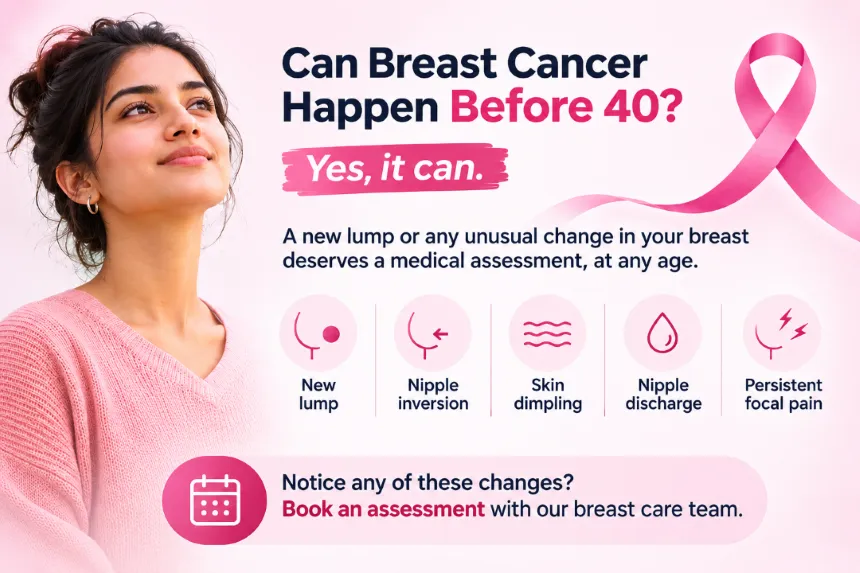

Yes, breast cancer can occur before 40, including in your twenties or thirties. It becomes more common with age, and most breast changes in younger women have benign causes. In recent years in India and generally most urban cities there has been a rising trend of breast cancer diagnosis in the 3rd and 4th decade which is almost a decade early compared to western population. If you feel a new, distinct lump or notice an unusual change, arrange an assessment even if you feel well otherwise. Age helps your clinician choose how to investigate. It cannot tell you what a lump is. [1, 2]
What should prompt an appointment?
Imagine noticing a new lump in the shower. It feels smooth, it moves a little, and it does not hurt. It is natural to wonder whether you can judge it by feel. The useful information is that it is new. Note where it is and when you first noticed it, and book an appointment. [1, 2]
Other changes worth getting checked include a new lump in the armpit, new nipple inversion, skin dimpling or a persistent change around the nipple. Discharge that comes out on its own from one nipple, particularly if clear or bloody, also deserves assessment. Tell your clinician about focal pain that keeps returning to the same spot, especially when you can feel or see another change there. [1]
What if breast cancer runs in my family?
Tell your clinician about breast or ovarian cancer in relatives on both sides of your family.The history on both paternal and maternal side is important . If you can, find out the relative’s age at diagnosis and which cancer they had adds more meaning for evaluation. Breast cancer in a close relative at a young age, male breast cancer, ovarian cancer or a pattern of related cancers in the family can prompt a formal risk assessment. An inherited variant such as BRCA1 or BRCA2, chest radiotherapy at a young age, or certain previous breast diagnoses can also change your surveillance plan. Some women at higher risk may be offered MRI and mammography earlier. [3, 4]
A risk assessment is useful even when you feel well. If you have a new symptom, have it assessed whether or not you know your family history. You can bring useful family details later if you do not have them when you book the visit. [1, 3]
Will I need a mammogram?
It depends on what brought you to the clinic. Screening is for people without symptoms. Diagnostic evaluation investigates a specific change. For a woman at average risk without symptoms, routine mammography is generally not started before 40. When there is a lump, diagnostic imaging can be appropriate at any age. [2, 4]

These are general starting points. Tell the clinician if you are pregnant or breastfeeding, or if you have had a previous breast procedure. That information can affect how the investigation is planned. [2, 5, 6]
What if the scan is reassuring and I can still feel the lump?
Ask whether the report explains what you can feel. A scan can sometimes show a clear explanation, such as a simple fluid-filled cyst. Sometimes the radiologist recommends a repeat scan to check stability. If a lump remains clinically concerning despite reassuring imaging, your clinician may recommend further assessment or biopsy. A core needle biopsy takes small samples of tissue to help establish what the lump is. [2]
Before you leave, ask three questions. What explains the change? What happens next? When should I come back if I can still feel it? If a repeat scan is advised, record the date and who will review it. If the area changes before then, contact your clinician.
What to remember
A new lump deserves assessment before 40, even if it is painless or you have no known family history. Your age helps guide the choice of test. The examination and imaging together help determine the next step.
Frequently asked questions
Can a 25-year-old develop breast cancer? Yes, although it is uncommon. A new or concerning change should still be assessed. [1, 3]
Should I have a breast ultrasound every year if I’m under 40? Routine annual ultrasound is generally unnecessary for women without symptoms at average risk. If you have a lump, ultrasound may be used to investigate it. [2, 4]
Does a normal ultrasound settle the question? It can be reassuring. If you can still feel a distinct lump or your clinician remains concerned, ask whether further assessment is needed. [2]
Do I need genetic testing if one relative had breast cancer? The decision depends on the relative’s age at diagnosis, how they are related to you, and the wider pattern of cancer in your family. A risk assessment or genetic counselling can help you decide. [3]