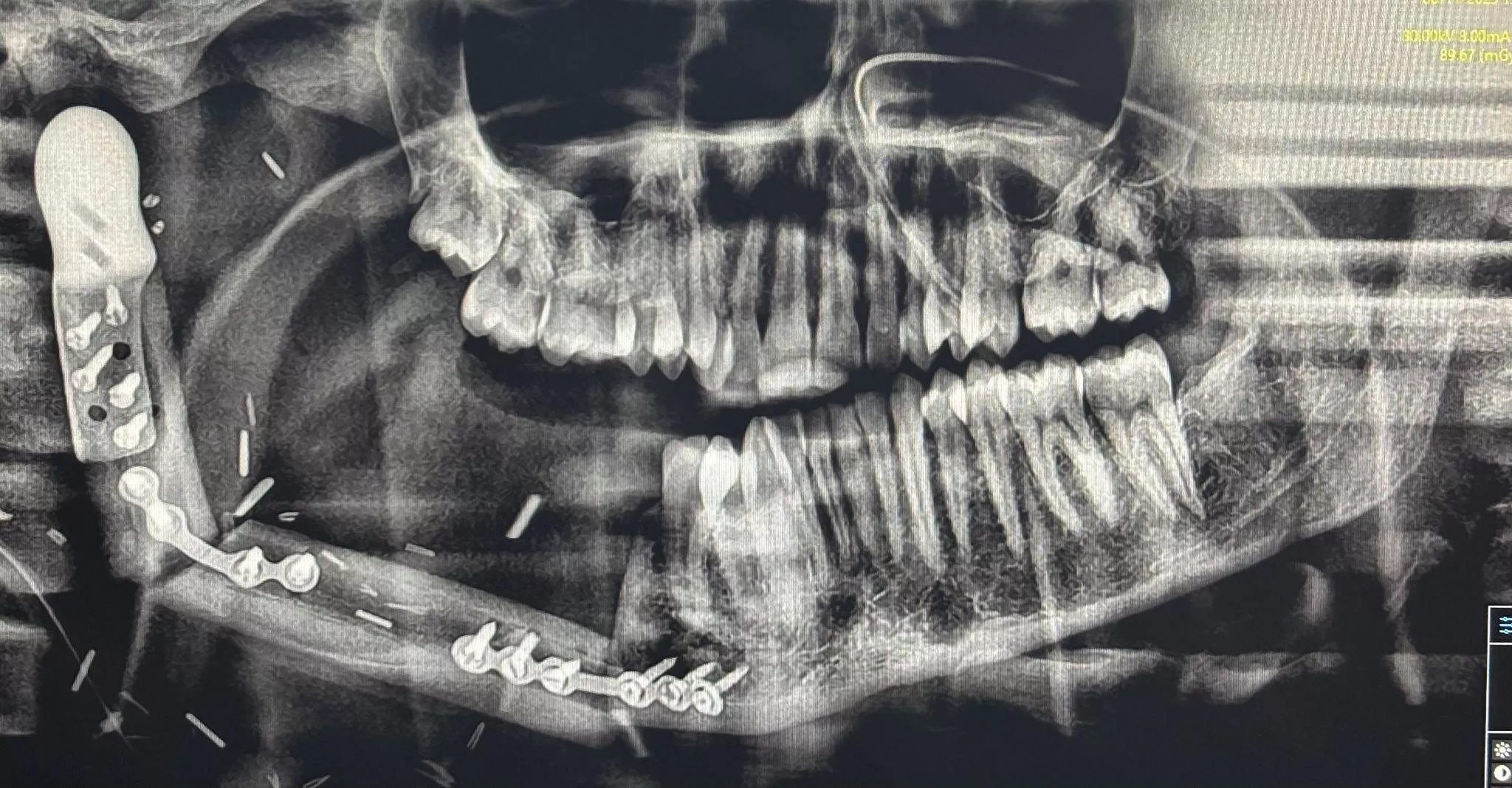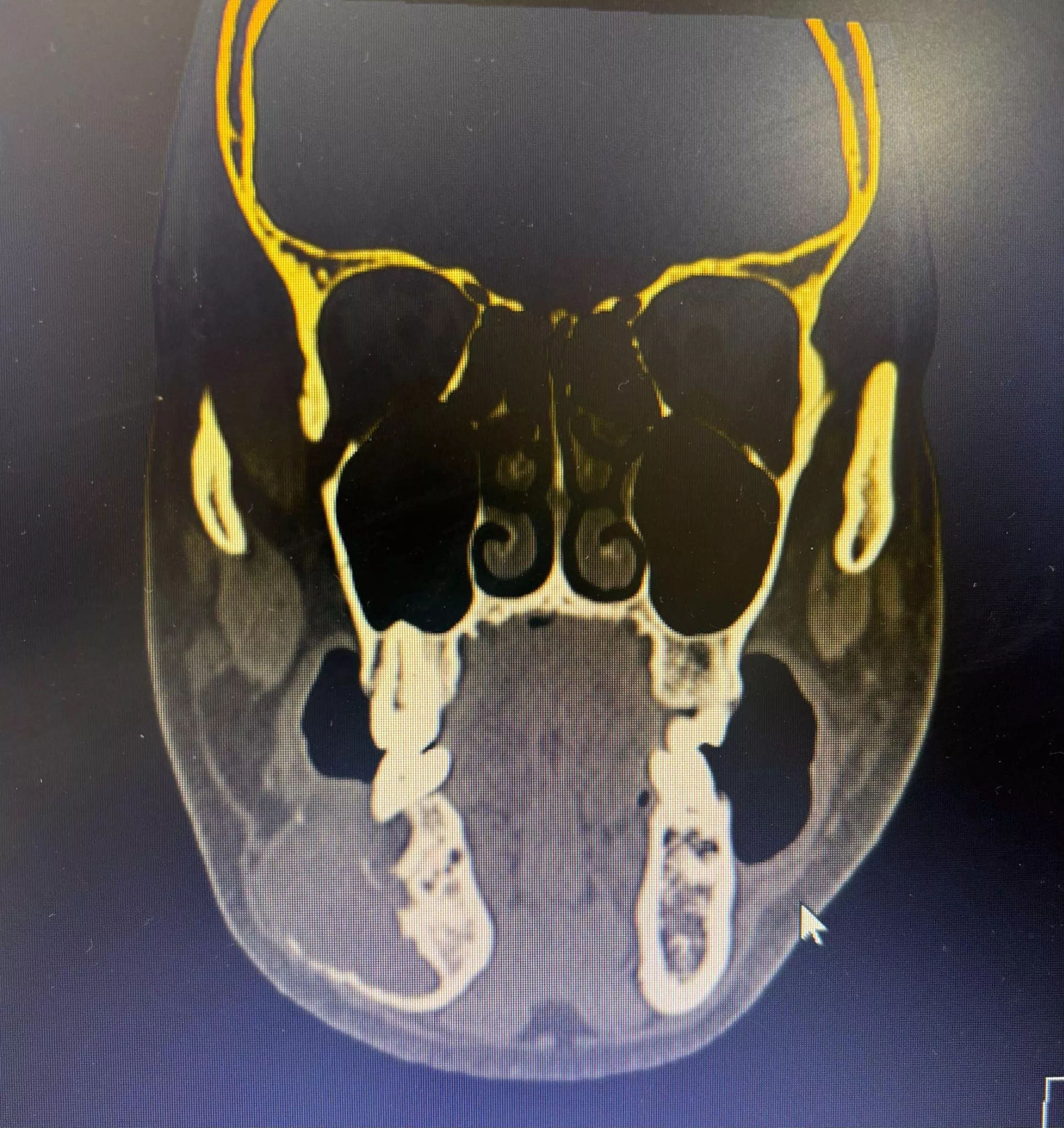
A 35-year-old male presented with swelling over the right mandibular body associated with mild discomfort and difficulty in mastication.
Orthopantomogram revealed a multilocular “soap bubble” radiolucency involving the right mandibular body. Computed tomography confirmed an expansile lesion confined to the mandibular body without condylar involvement. Histopathological examination confirmed ameloblastoma.
Virtual surgical planning was performed to simulate segmental resection of the right mandibular body while preserving the condyle. Fibula flap reconstruction was planned using CAD-CAM technology, and patient-specific cutting guides and a pre-bent plate were fabricated.
Discussion
These cases illustrate the application and versatility of virtual surgical planning (VSP) in mandibular reconstruction across varying defect complexities. The first case involved a composite defect of the mandibular ramus and condyle reconstructed using a free fibula flap in combination with a patient-specific temporomandibular joint (TMJ) prosthesis, whereas the second case represented a segmental mandibular body defect managed with fibula reconstruction alone. Together, they highlight the adaptability of VSP-based workflows in both complex and standard reconstructive scenarios.
VSP represents a paradigm shift in maxillofacial reconstruction, transitioning surgical planning from intraoperative estimation to preoperative, computer-assisted precision. It enables three-dimensional simulation of resection margins, preoperative design of osteotomies, fabrication of patient-specific cutting guides, and accurate reconstruction using CAD-CAM–derived plates and implants. This approach improves reproducibility, reduces intraoperative variability, and facilitates improved functional and aesthetic outcomes.
The conceptual development of VSP can be traced to early advances in medical imaging and stereolithographic modeling in the late 1980s and 1990s. With subsequent improvements in computed tomography resolution and computer-aided design technologies, these methods evolved into integrated CAD-CAM workflows in the early 2000s. Over the last decade, VSP has become increasingly established in craniofacial reconstruction, particularly for ablative oncology defects and complex mandibular reconstructions requiring precise restoration of form and function. Its extension to patient-specific TMJ prosthetic reconstruction represents a further evolution toward fully individualized reconstructive strategies.
Despite its growing global adoption, the implementation of VSP in India remains uneven. Its use is largely concentrated in high-volume tertiary care centers and select private institutions, while access in tier 2 and tier 3 cities remains limited. This disparity is primarily attributed to infrastructural constraints, cost considerations, limited availability of dedicated CAD-CAM support services, and dependence on external manufacturing facilities. Consequently, conventional reconstruction techniques continue to be widely employed in many centers.
Nevertheless, there is a gradual increase in adoption within India, driven by improved awareness, expanding digital surgical infrastructure, and increased collaboration between surgical teams and engineering platforms. The present cases demonstrate the feasibility of integrating VSP into routine clinical practice, even within resource-variable settings, and underscore its potential to become more widely accessible in the future.
The most notable advancement in the present report is demonstrated in Case 1, where a patient-specific TMJ prosthesis was successfully integrated with a fibula free flap using a fully virtual workflow. This hybrid reconstruction enabled simultaneous restoration of mandibular continuity and temporomandibular joint function, illustrating the potential of VSP-enabled biological–prosthetic integration in complex mandibular defects.
Conclusion
Virtual surgical planning significantly enhances the precision, predictability, and efficiency of mandibular reconstruction. Its integration with free fibula flap reconstruction and patient-specific temporomandibular joint prosthesis enables comprehensive restoration of complex mandibular defects. These cases highlight the transformative role of VSP in advancing toward fully personalized, digitally driven maxillofacial reconstruction.