
Abstract
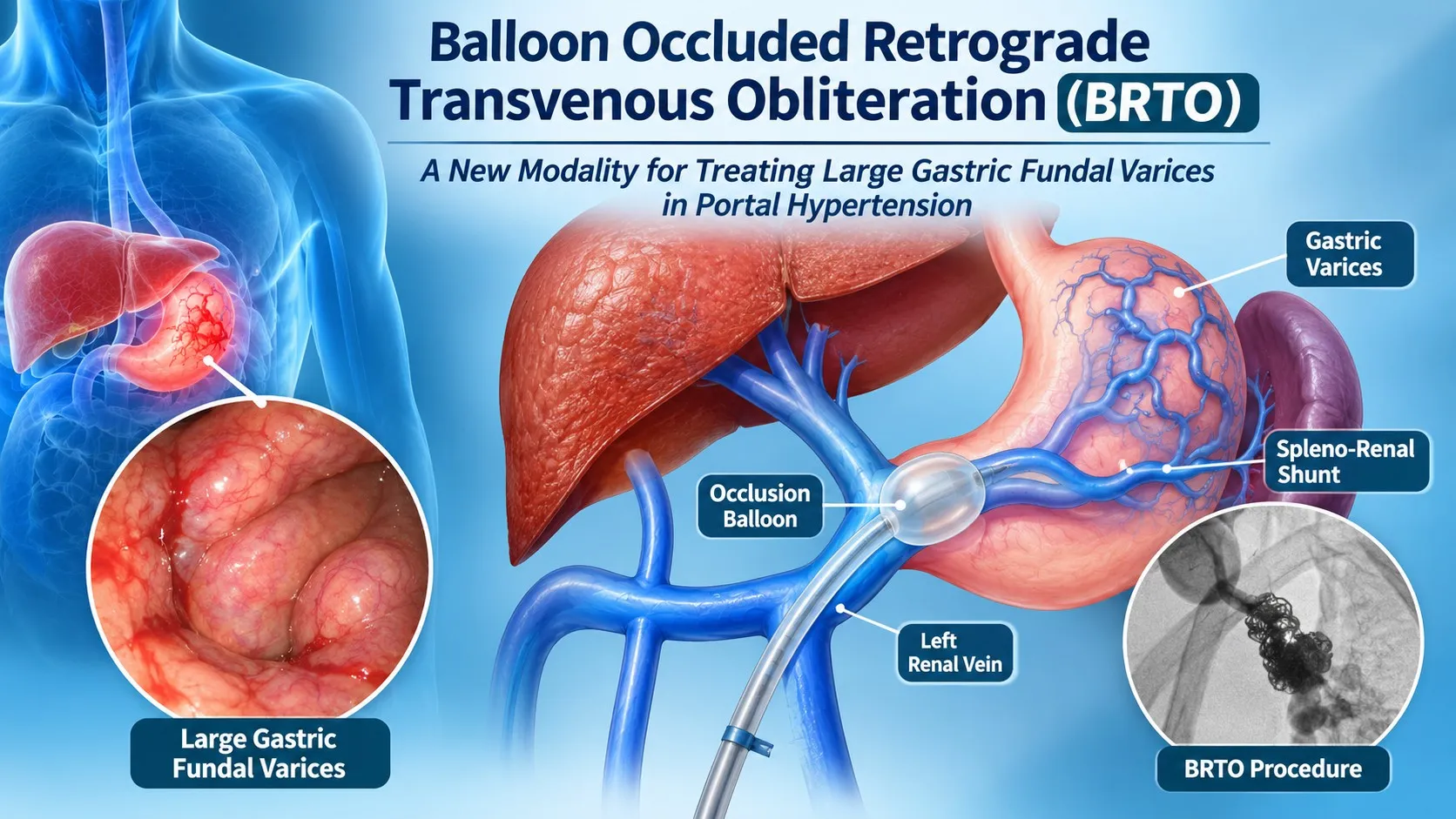
This article presents case of large fundal varices due to portal hypertension with chronic liver disease treated with newer radiological method: BRTO.
Introduction
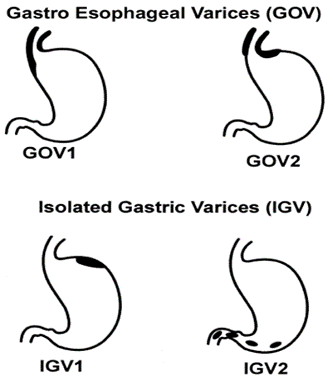
Gastric varices occur in 20% of patients with portal hypertension either in isolation/combination with EV. Gastric varices are commonly classified as per Sarin classification. GV have high re-bleeding rate (34% to 89%). Although GV bleed less frequently than EV, bleeding tends to be more severe. Mortality from a first variceal bleed remains as high as 20% within within first 6 weeks.
Classification of gastric varices by Sarin et al.
Case Report
31 year female presented to emergency department with history of vomiting large quantity of blood for last 2 hour. She was admitted in Intensive care unit (ICU) and evaluation showed features of chronic liver disease (etiology under evaluation) with splenomegaly, pancytopenia. She received 4 units of blood transfusion with medical management (inj.Terlipressin ,supportive therapy) of portal hypertension .Upper GI scopy showed large gastric fundal varices ( GOV type 2) with evidence of recent bleeding and grade I esophageal varices . She underwent CT scan of abdomen and pelvis ( IV contrast) which showed features of large sub-mucosal gastric region varices with patent large spleno-renal shunt .
She required obliteration of large fundal varices so as to prevent next episode of massive G I bleeding.
She underwent BRTO procedure for obliteration of fundal varices .
BRTO procedure :
The left renal vein and then subsequently splenorenal shunt was canulated .The terumo guide wire was exchanged with stiff wire and then 11.5 Fr standard occlusion balloon was kept inflated at junction of renal vein and shunt opening. A balloon occlusion venogram was taken which revealed dilated tortuous venous channels with outflow vein filling the portal venous system. Using micro catheter 20 ml of mix of inj lipoidol with sclerosant sodium tetradecyl sulphate was injected slowly under fluoroscopic control. Occlusion balloon was kept inflated in situ for 4 hours post procedure. Patient was monitored in the ICU for 6 hours . After 6 hours, check venogram was done which revealed 6thcomplete obilteration of varices. Balloon was then deflated.
Post procedure 15 days and six months plain C T abdomen and upper GI scopy was repeated for shrinkage of gastric varices. Patient did not have bleeding episode from the gastric varices.
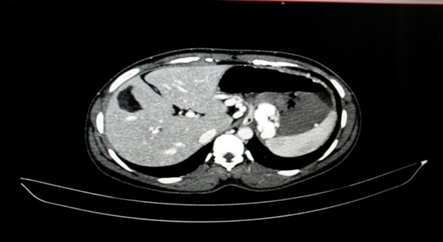
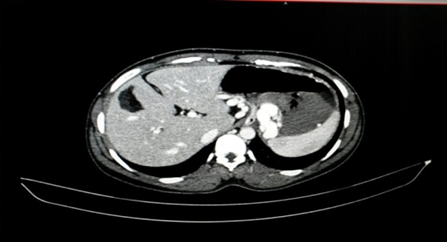
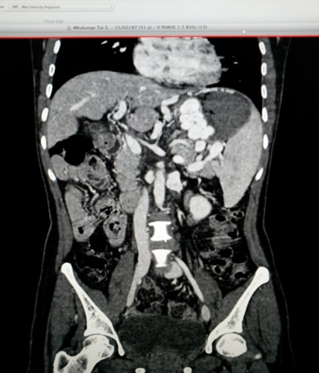
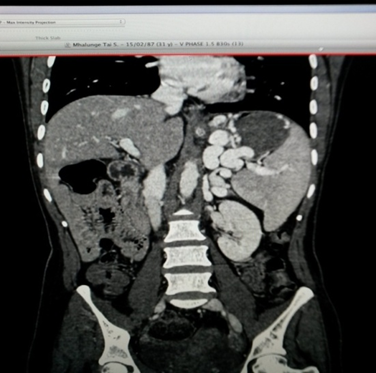
Fig : C T scan of abdomen with IV contrast done pre therapy
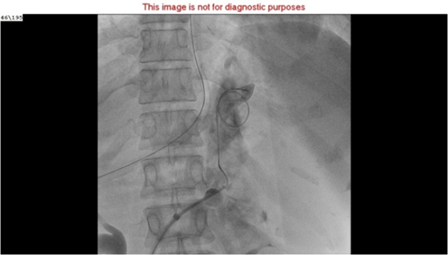
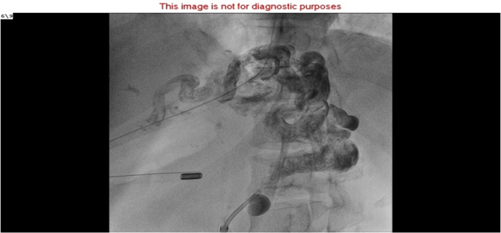
Fig : BRTO procedure.
Discussion
Management options for controlling acute gastric variceal bleeding are : Glue injection , TIPS ( transjugular Intrahepatic portosystemic shunt ) , BRTO and open devasularization surgery .
Traditionally gastric varices are treated with endoscopic cynoacralate glue injection therapy. This therapy requires injection of 1 ml of N butyl cynoacrylate ( popularly known as glue) into the varix under direct vision control. Large gastric varices requires multiple injections of glue in multiple setting , causing increased risk of bleeding during and after glue injection.
BRTO is effective and safe procedure for treatment of gastric varices with favorable anatomy ( large spleno-renal shunt). Two major indications of BRTO are 1) impending prior or active large gastric variceal bleeding 2) gastric varices with hepatic encephalopathy refractory to glue injection. Majority of gastric varices are associated with spontaneous left sided portosystemic shunts. The formation of these shunts results in decreasing portal pressure. Leino-renal shunt are most common .These shunt create outflow from gastric varices to the left renal vein. This shunt anatomy is used during BRTO procedure as shown in diagram. Relative contraindication for BRTO are : severe uncontrolled coagulpathy , portal vein/splenic vein thrombosis, uncontrolled esophageal varices bleeding. BRTO increase hepatic blood flow and liver function , thereby improving hepatic encephalopathy . BRTO has few limitations also. BRTO increase development of new onset esophageal varices , ascites .
Common Complications seen post BRTO procedure are fever, epigastric / chest pain .
BRTO has excellent success rate ( 79% to 100%) . Recent study from ILBS , new Delhi showed good outcomes with lower GI bleeding , higher survival after BRTO ( INASL journal 2020)
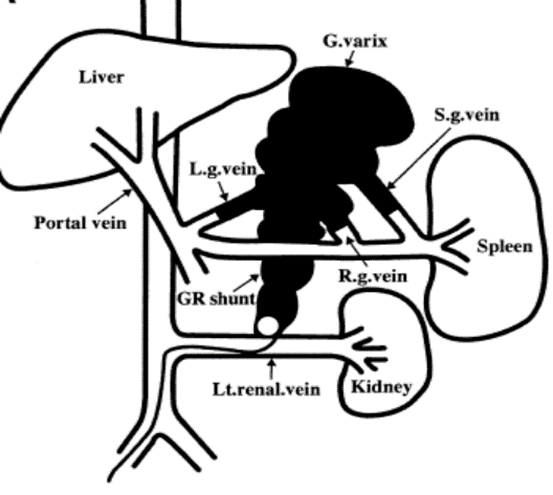
Fig : Diagramatic Representation of BRTO procedure.
TIPS therapy is useful in decreasing portal hypertension ( esophageal / fundal / portal gastropathy / ectopic varices pressure) and commonly used as rescue therapy after glue injection . TIPS has success rate of 90 – 96%. But this procedure carries risk of development of hepatic encephalopathy ( due to shunting of blood and ammonia across liver ). TIPS is ideally not suitable for child “C” CTP score , advanced MELD score liver disease patients.
Summary
Esophageal and gastric variceal bleeding due to portal hypertension is medial emergency in gastroenterology ICU.
Gastric variceal bleeding is more severe , having high rebleeding rate with increased mortality . Gastric varies are traditionally treated with sclerotherapy using n-butyl cynoarylate glue injection. But large gastric varies require multiple sessions of glue injection or alternative definitive therapy ( TIPS or BRTO ). TIPS therapy puts patient under risk of encephalopathy . BRTO is newer , safer and effective method ( avoiding side effects of TIPS therapy ). Only favourable anatomy ( large patent leno renal shunt ) is pre condition for the procedure.