by Dr. Poornima Narayanan Nambiar
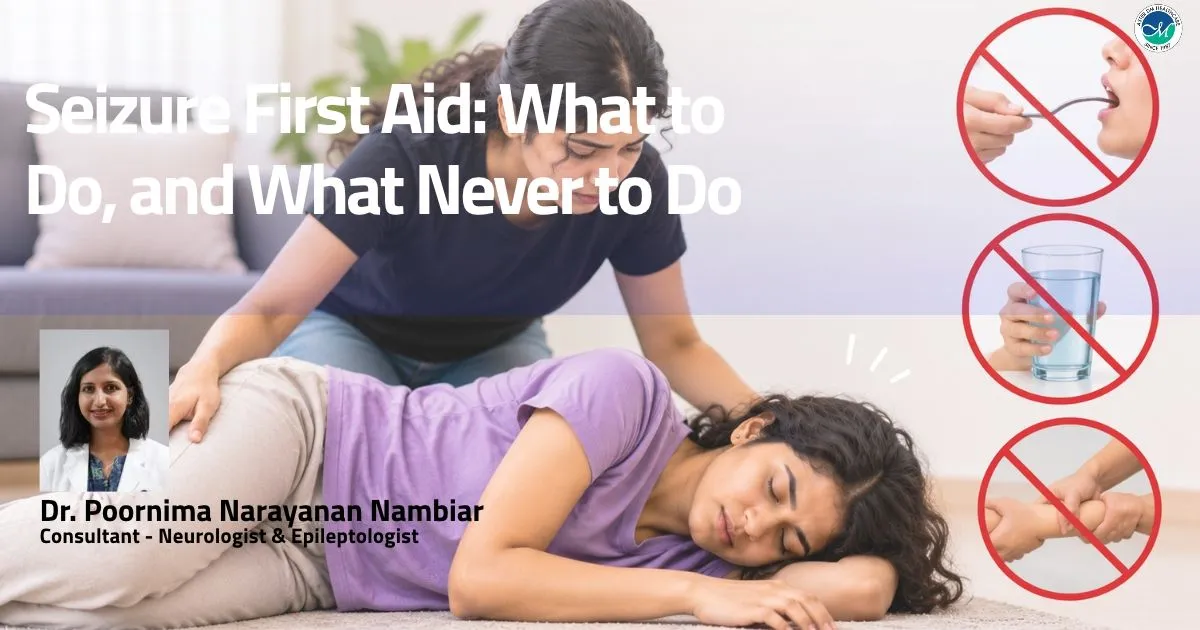

Imagine you are at a wedding, a bus stop or the office canteen when someone nearby suddenly falls and starts shaking. People gasp. Someone shouts for water. Someone else tries to hold the person down. In those few chaotic seconds, what you do can make the difference between a scary moment and an injury.
The good news is that seizure first aid is simple. You do not need medical training. You need a calm head and a few clear steps.
First, stay calm and watch the clock
Most seizures stop on their own within one to three minutes. Take a quick look at your watch or phone and note when it began. Timing matters because doctors and paramedics will want to know how long it lasted. Take a breath. Your calm will help everyone around you stay calm too.
Make the space safe
The main danger in a seizure is not the seizure itself but what the person might hit while it is happening. So:
• Move hard, sharp or hot objects away from them.
• Ask onlookers to step back and give them room.
• If they are in a dangerous spot, such as the middle of a road or near stairs, gently guide them to safety only if you can do so without struggling with them.
• Slip something soft, like a folded jacket or a bag, under their head.
• Loosen anything tight around the neck, such as a tie, scarf or top button.
• Remove their spectacles if they are wearing any.
Do not hold them down
It is natural to want to stop the shaking, but restraining someone during a seizure can cause injury to them and to you. The muscle contractions are involuntary and surprisingly strong. Let the seizure run its course while you protect them from harm.
Never put anything in their mouth
This is the most important rule, and the most common mistake. A person having a seizure cannot swallow their tongue. Putting a spoon, a cloth, your fingers or even water into their mouth can damage teeth, block the airway or injure you. Do not give food, drink or tablets until they are fully awake and alert.
Once the shaking stops: the recovery position
When the jerking ends, the person is usually drowsy, confused or unresponsive for a while. Help them into the recovery position:
1. Gently roll them onto their side.
2. Tilt the head slightly back so the airway stays open.
3. Rest the upper arm and leg so the body is stable and does not roll back.
4. If there is saliva or vomit, let it drain from the mouth.
Check that they are breathing normally. Stay with them. Speak softly and reassure them: tell them who you are, where they are and that they are safe. They may feel embarrassed, frightened or exhausted, so be gentle and do not crowd them.
When to call for emergency help
Most seizures are not emergencies, but please call an ambulance or get the person to hospital straight away if:
• The seizure lasts more than five minutes.
• A second seizure follows soon after the first, without the person waking up in between.
• The person is having difficulty breathing or does not start breathing normally afterwards.
• It is their first ever seizure.
• They are injured, pregnant, or have diabetes.
• The seizure happened in water.
• They do not wake up within a reasonable time after the seizure ends.
If you are unsure, it is always safer to call for help.
Myths that can hurt
You may have heard that giving someone an onion, a key or a shoe to smell will stop a seizure. There is no evidence for any of this, and it only wastes precious time and can distract you from proper care. Stick to the basics: keep them safe, keep them on their side, stay beside them.
After the seizure
Once the person is awake and alert, offer a calm explanation of what happened, since they may not remember. Let them rest. If they have a seizure diary or medical ID, it can help to note the time, duration and what the seizure looked like. Share these details with their family or doctor. If it was their first seizure, encourage them to see a neurologist soon.
If you are a parent, teacher, coach, security guard or supervisor, it is worth speaking to your team about these steps in advance. Schools and workplaces that are prepared respond far better and make the person feel respected rather than embarrassed.
A quick checklist to remember
• Stay with the person and note the time.
• Protect them from injury and cushion the head.
• Turn them onto their side when the shaking stops.
• Never restrain them or put anything in their mouth.
• Call for help if the seizure is long, repeated or unusual.
Seizure first aid is not complicated. It is about patience, safety and kindness. Knowing these few steps could turn a frightening situation into one where a person gets exactly the care they need.