
The term “hernia” often causes confusion and concern. You may notice a swelling in the abdomen or groin. As a result, discomfort becomes an everyday thing. For instance, you may experience uneasiness when lifting something, coughing or even standing for long hours. Well, these concerns are common, and you are not alone.
A hernia happens when an internal organ or tissue pushes through a weak spot in a connective tissue or surrounding muscle. In most cases, this occurs in the abdominal wall. But again, there are various types of hernia. Also, each of their symptoms differ and have differing impacts. Understanding their impact on your life is key to making informed decisions about your health.
That being said, let us dive into this blog to learn the types of hernia and how experts at a general surgery hospital in India offer evidence-based treatment.
What are the main types of hernia?
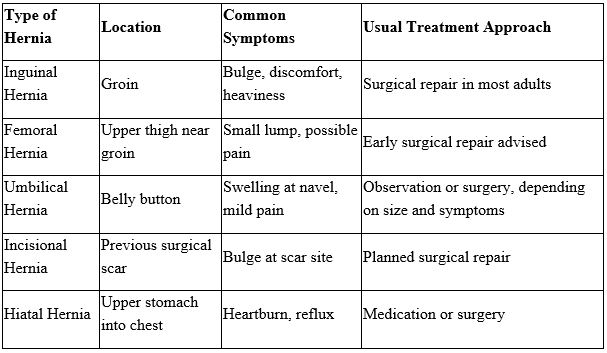
1- Inguinal hernia
This type of hernia occurs in the groin area. It is most common in men but can also affect women. An inguinal hernia develops when part of the intestine or fatty tissue pushes through a weak area in the lower abdominal wall.
You may notice a bulge in the groin. The swelling may become more visible when you cough or strain. You may also feel heaviness, burning or mild pain.
Inguinal hernia is the leading cause of hernia surgery across the globe.
2- Femoral hernia
This type of hernia appears just below the groin crease, typically in the upper thigh area. Femoral hernia is very common in women, especially older women.
This hernia presents itself as a small lump in the initial days. However, it carries a higher risk of complications if left untreated. This is why early medical evaluation is important.
3- Umbilical hernia
As the name suggests, this hernia develops around the belly button. It can affect infants, but adults can also develop it. This is especially the case post pregnancy or after significant weight gain.
Umbilical hernia often appears as a soft swelling near the navel. It may cause discomfort when bending or lifting. In many adults, surgical repair is critical to prevent future complications.
4- Incisional hernia
This type of hernia occurs at the site of a previous surgical incision. It develops when the abdominal wall doesn’t heal strongly after surgery.
You may notice a bulge near an old scar. The swelling may increase with time. This type of hernia often needs planned hernia surgery to repair the weakened area.
5- Hiatal hernia
This type of hernia is different from other abdominal wall hernias. It occurs when part of the stomach moves upward into the chest through an opening in the diaphragm.
Instead of a visible bulge, you may experience heartburn or acid reflux. Even chest discomfort is a very common symptom. Many hiatal hernias are managed with medication. But again, some cases need surgery.
How do hernias affect your daily life?
In the early stages, a hernia might cause mild discomfort. Oftentimes, people ignore the pain because it is not severe. But again, even small hernias can have a huge impact on daily routine.
For instance, it can become difficult to lift objects. You may avoid exercise. Long periods of standing could result in heaviness, too. Some patients often feel embarrassed about visible swelling.
If the hernia becomes large, pain may increase. And in rare cases, the trapped intestine blood can lose blood supply. As a result, you may require urgent care.
Hiatal hernia can impact your eating habits. For instance, persistent reflux might disturb your sleep. With time, your overall quality of life can get impacted.
Consider visiting a trusted general surgery hospital so experts can assess how the hernia affects your physical comfort and work routine. They can equip you with treatment plans that can restore your normal lifestyle safely.
What do you expect during recovery?
It is natural to feel anxious when you hear the term “hernia surgery.” You may worry about the pain or recovery time. You may wonder what complications await. Well, relax; modern surgical techniques are safe and effective.
In adults, most abdominal wall hernias eventually require hernia surgery. Surgery is usually recommended if:
- The hernia causes pain
- The swelling increases in size
- Daily activities become difficult
- There is a risk of obstruction
General surgeons in India commonly perform hernia repair using laparoscopic and robotic surgery techniques. As per this surgery, small incisions are made, and a camera guides the repair. This approach helps with less pain and faster recovery.
A mesh is often used to strengthen the weakened area. This reduces the risk of recurrence. Your surgeon will discuss the most suitable option as per your health condition.
Why does early consultation matter?
Given the early symptoms seem mild, many patients delay care. Others fear surgery. However, early evaluation is critical. It often leads to simpler treatment and smoother recovery.
At a comprehensive general surgery hospital in India, multidisciplinary teams review each case carefully. They perform imaging tests, physical examinations as well as risk assessments to make treatment decisions.
General surgeons in India are trained to address both routine and complex hernias. Their goal is to detect, repair and help you return to an active, comfortable life.
Ending note
Hernia is a very common condition, affecting hundreds, if not thousands, of people. However, it can significantly affect your daily life. You may feel discomfort and limitation in movement. Likewise, it is easy to experience anxiety about complications. And all of these feelings are valid.
The good news is that most hernias can be treated safely. With appropriate evaluation and timely hernia surgery, it is easy to get back to normal activities with confidence.
If you or a loved one is experiencing the above-listed symptoms, visit a general surgery hospital in India right away. The experts at such clinics will offer expert guidance.
FAQs
1- Can a hernia heal without surgery?
Hernias, in adults, do not heal on their own. The muscle remains weak, causing the tissues to push through. Surgery is often a definitive treatment.
2- Is hernia surgery painful?
Modern techniques are aimed at minimising pain. However, a lot of patients mention experiencing mild discomfort, which goes away within a few days.
3- How long does recovery take after hernia surgery?
Recovery from hernia surgery depends upon the surgical approach and type of hernia. A lot of patients are able to resume activities within one or two weeks.
4- What happens if a hernia is left untreated?
An untreated hernia can enlarge with time. It is only in rare cases that a hernia can cause complications like obstruction. And when that happens, emergency treatment is mandatory.