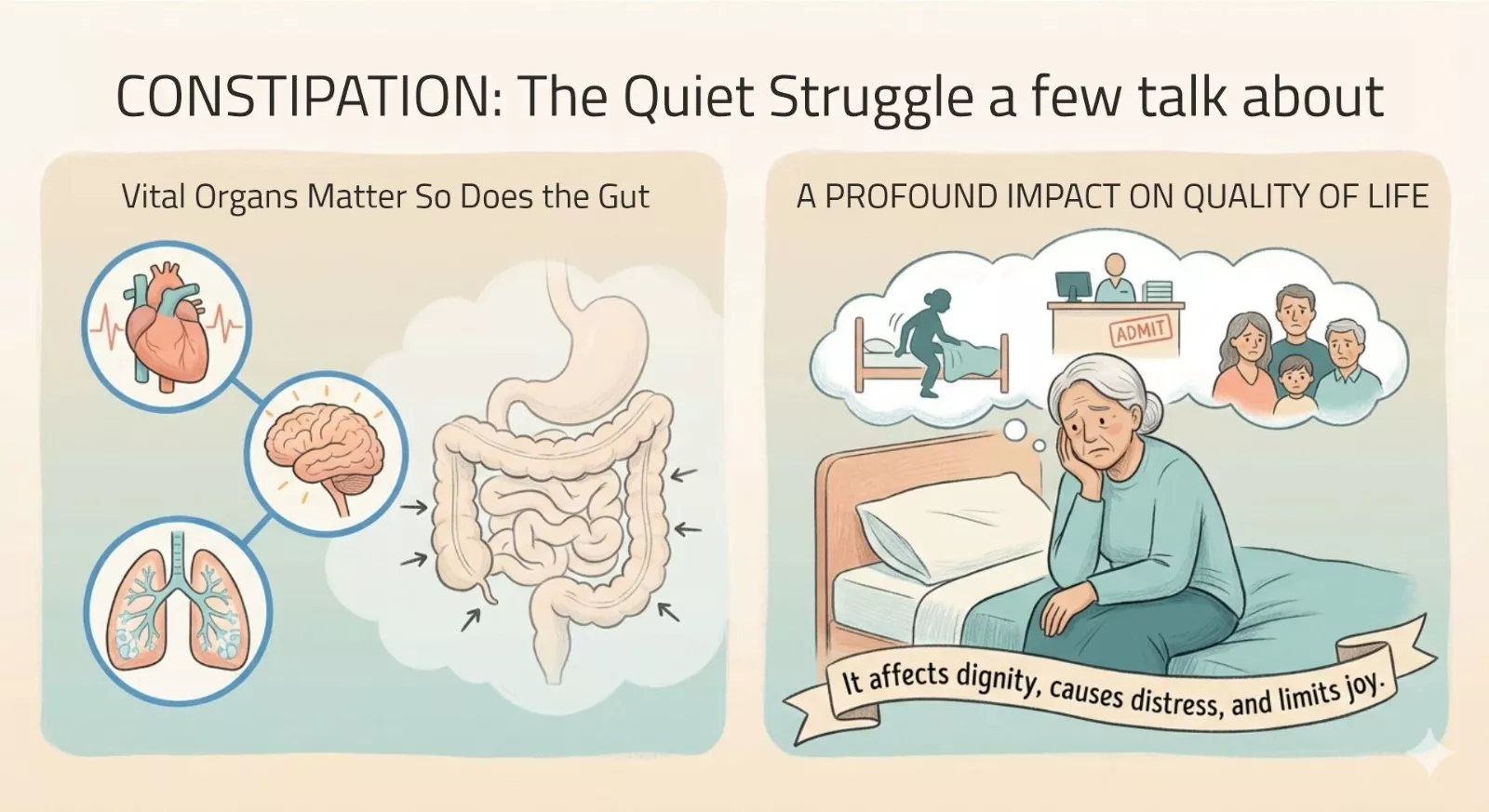

While a lot of importance is given to organs such as heart, brain, lungs, many overlook the
issues involving digestive tract or bowels such as constipation. Nevertheless constipation has a
profound impact on the quality of life for patients with serious illnesses, and their families too.
This in turn results in unnecessary complications and hospital admissions.
What was earlier a simple task or a subconscious nature call, becomes a cause of distress, a
threat to dignity.
Why Constipation Goes Unnoticed
To address any problem, we need to define and understand the problem. One of the common
barriers of managing constipation is its misconception among patients and their caregivers.
Constipation isn't necessarily just unable to pass motion for more than 2 days. Everybody has
different bowel habits.
So if you are waiting longer than usual for nature to call, or you are pushing harder than usual in
the bathroom, you are probably constipated. If you feel like you can’t finish your bowel
movement, or you feel bloated or gassy, you’re probably constipated.
Another reason for underestimating constipation is due to patients and their families correlating
constipation to low oral intake and appetite. But our gastrointestinal tract produces upto 8-10L
secretions per day. Normally, around 80% gets reabsorbed by our intestines. But in serious
illnesses, this process is dysfunctional. Thus daily passing of stools is important, else these
secretions along with toxic metabolites accumulate, further increasing suffering.
From ‘No Big Deal’ to ‘What’s happening to Them/Me?’ Real Quick
For patients with serious illnesses, the presentation of constipation isn’t always related to
passing stools. Hence patients and family may be unaware of the other presentations. Their
symptoms vary from nausea, vomiting, low appetite to blocked intestines. If you come across
distressing pain in the abdomen, bloating, indigestion (to name a few more), please do visit the
Pain and Palliative team at Aster CMI Hospital, Hebbal.
The psychological impact of constipation is furthermore overwhelming. From confused state of
mind, lack of sleep, generalized body distress to isolating oneself from loved ones and society,
are some of unexpected yet common effects.
It can even make it hard for your body to absorb your medicines.
Hence managing constipation is an important issue.
Mission “Impoopable” : Cracking the Constipation Code
1. Prevention is better than cure
There are multiple risk factors for constipation in serious illness. Some of them are age,
decreased mobility, reduced food/fiber intake, reduced fluid intake, pain, medications. Even
hospitalization is a risk. And how do you think not having privacy to perform a basic human
function would affect the same?
Thus non medical methods help avoid constipation: improving nutrition by increasing the
frequency of feeds while reducing the amount and softening the consistency of feeds; improving
hydration, supporting and encouraging increased mobility.
Pre-emptively starting laxatives for certain medications such as opioids and conditions such as
chronic respiratory disease, will also prevent constipation.
2. Gut Brain axis- bottling emotions = bottling… other things too
Constipation is more than just a physical issue- psychological factors can both cause
and worsen constipation.
Some key psychological aspects are:
○ Stress- the ultimate gut disruptor.
■ It diverts energy away from the digestive system, making bowel
movements less frequent or harder.
○ Toilet Avoidance & Habits
■ Ignoring the urge to go (because of busy schedules, discomfort using
public restrooms, or embarrassment) can train your body to “hold it in,”
leading to chronic constipation over time.
○ Emotional Control & Personality Factors
■ People who tend to be overly controlled, perfectionistic, or anxious about
routines may unconsciously “hold on,” including physically. This
mind-body pattern can show up as constipation.
○ The Modern problem of Screen Constipation:
■ Gadgets and gut don't mix. Whether the drop in mobility, lack of routine or
poor sleep hygiene, there are numerous reasons why overt screen time
leads to not only your mind stuck, but a colon backlog too.
3. The eyes sees only what the mind knows
It is important to know the common manifestations of constipation. As mentioned earlier, it's not
just about not passing stools.
Constipation can be if:
● If your stool is hard or dry, it may be difficult to pass.
● If you have to push a lot or spend more time in the bathroom than usual, something may
be off.
● If it hurts when you pass stool or you notice bleeding, that’s a sign your body is
struggling.
● If it feels like the opening is tight when you try to go, it can make passing stool
uncomfortable.
● If you feel like you’re not fully empty even after going, your bowels may not be clearing
properly.
● If your stomach feels full or bloated, it could be due to buildup inside.
● If you get on-and-off stomach cramps, your gut might be under stress.
● If you feel nauseous along with stomach discomfort, your digestion may be affected.
In any of the above cases, its important to acknowledge the problem and consult your doctor.
Please visit Aster CMI hospital, to help you further.
4. Getting your stools in a row
Once constipation is identified, figuring out the cause is crucial. All constipation cannot be
addressed in the same way. Also, avoiding further constipation is equally important. For a critical
assessment and guide, Please do visit The Pain and Palliative team at Aster CMI.
Specific medications such as Laxatives can be given as oral or rectal administration. But non
pharmacological protocols such as rectal applications, mobilization, regular bowel routine, being
aware of the significance of posture, diet, hydration etc are just as important as medications.
5. Mind over motion
Never forget to address the person going through this situation. Ask them what they feel is the
reason behind their constipation. More often than not- their distress is unaccounted for. To name
a few reasons- they deem it a threat to dignity on relieving themselves on bed or the discomfort
of not being able to sit on a commode. Hence following a holistic approach is crucial to address
constipation.
6. Team in Motion
Everybody has a role to play from patient to doctor of various specialities to nurse to family. At
Aster CMI, there is an interdisciplinary approach to help things get moving. A team composed of
a Palliative specialist, Medical Gastroenterologist, Nutritionist, Physiotherapist, Nursing team
and Psychologist come together to plan the optimal steps to make your journey easier, quality of
life better.